Stockton’s Port Wine Bitters
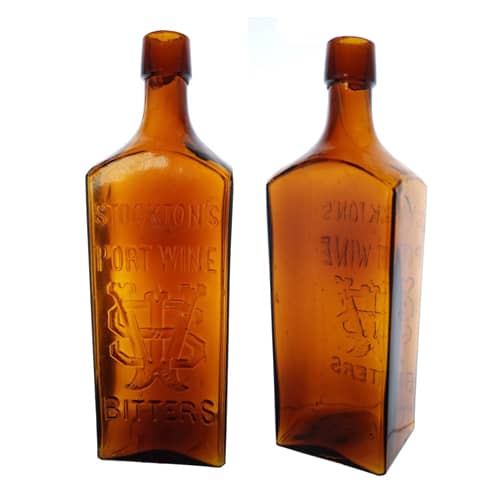
Stockton’s Port Wine Bitters
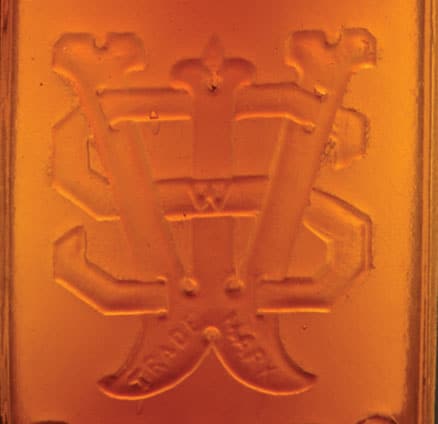
WWS Trade Mark (Monogram)
S 198
William Walter Stockton, San Jose, California
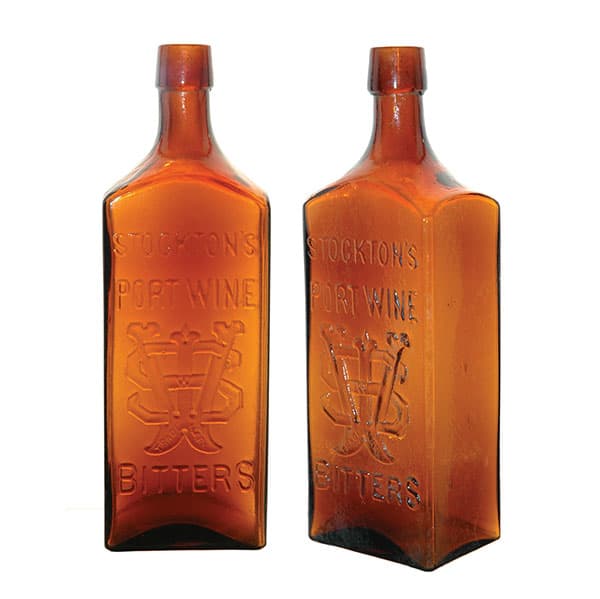
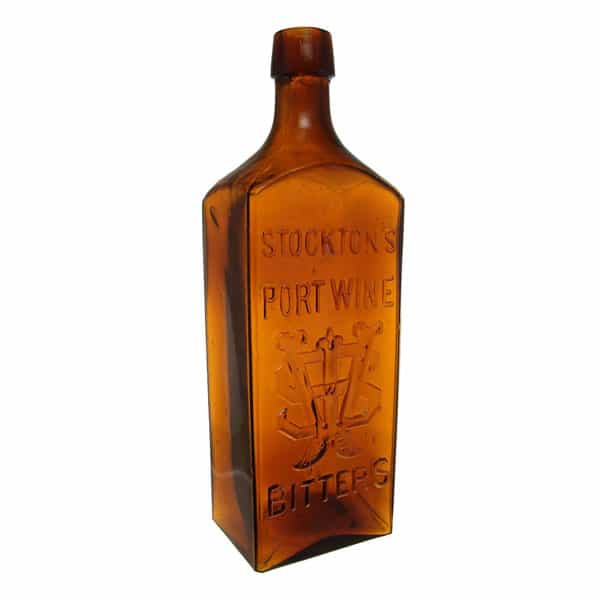
Amber Rectangle
Provenance: Steven Hubbell Collection
Stockton’s Port Wine Bitters is an interesting bottle as there are a few misconceptions that have circulated over the years. Initially, there was some confusion with the embossed word ‘STOCKTON.’ The general understanding was that this is a western bitters as it states this in Bitters Bottles and the bottle showed up in a 2012 Top 25 Western Bitters Survey list. Some thought that Stockton meant Stockton, California, a city on the San Joaquin River, in California’s Central Valley. Actually, Stockton is for William W. Stockton of San Jose, California.
William W. Stockton
William W. Stockton was the son of Nathaniel Hiram Stockton, born in Tennessee on November 6, 1818, and Mary Lynn. Nathaniel married Mary on October 17, 1852, in Watsonville, California, and resided near Santa Cruz, California, where their six children were born. Their oldest son, William Walter Stockton, was born in Santa Cruz on June 30, 1857. Nathaniel then moved his family to San Jose in 1862, where N. H. Stockton engaged in viticulture. William was to graduate from San Jose State Normal School, which was established as a teacher’s college and is known today as San Jose State University.
By March 1882, William entered into a partnership with fellow San Jose resident, Lewis B. Wilson. Stockton opened a wine store in San Jose and Wilson opened a branch store in Grass Valley.
Stockton’s short-lived partnership with Lewis B. Wilson ended when Wilson was declared insolvent in Grass Valley. William wasted no time in creating a new business under the name of W. W. Stockton & Co. This was most certainly a business formed for the purpose of selling wines and such from his father’s own extensive vineyards and soon included his Stockton’s Celebrated Malvoisie Port Wine Bitters.
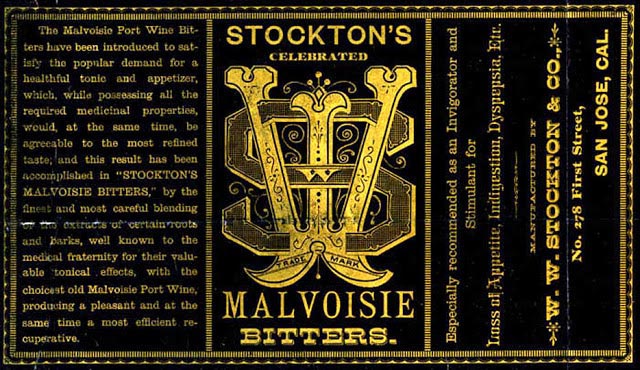
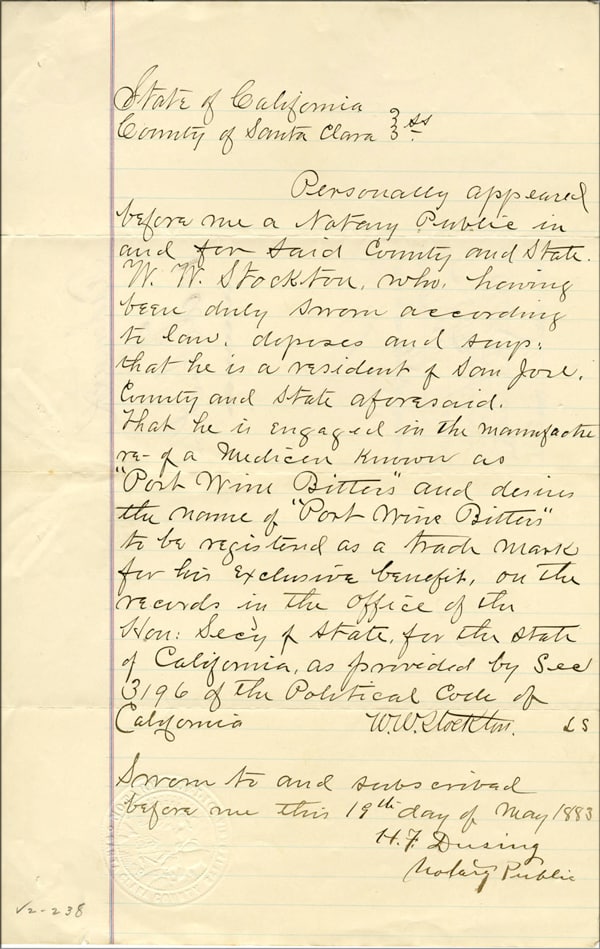
An original label for Stockton’s Port Wine Bitters was included with his trade-mark registration for the brand, deposited with the California Secretary of State as trade-mark Number 971 on April 9, 1883. The California State Archives, a division of the California Secretary of State’s Office has the following document on file.
A newspaper advertisement for his bitters originally incorporated the word “Malvoisie” which represented the initial grape variety used to compound the product.
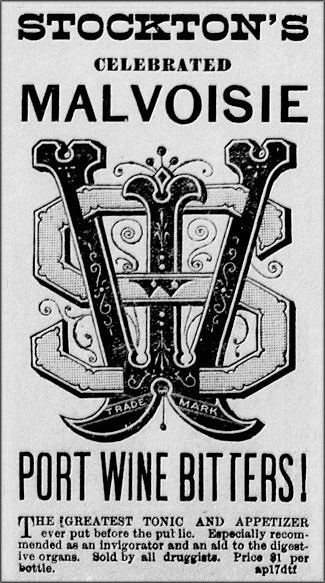
The malvoisie grape, or malvasia in Italian, is a European species of the Vitus vinifera family, (aka Vitus vinifera “Cinsaut”). It has been commonly used in the production of port wines for many generations, and was a freely planted grape in the early orchards of California, especially Napa and San Jose. As different grape varieties became better tested in the new California geography, it was noted that the Malvoisie grape was not as hardy as first expected and fell out of favor by the early 1880s.
By June 1883, the word Malvoisie was no longer used in Stockton’s Port Wine Bitters advertising. This probably represented a switch to the use of the more abundant Zinfandel grape from the much larger vineyards of his father’s Madera properties.
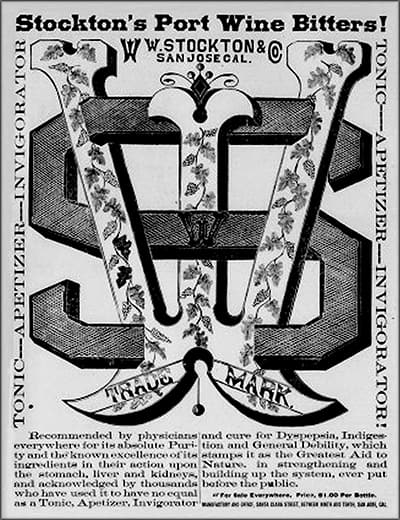
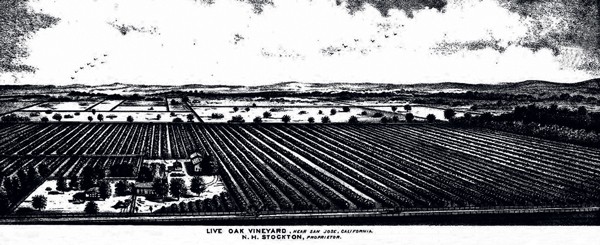
All documentation indicated a successful business venture that was to be an excellent financial success to both Stockton and the city of San Jose. Much of Stockton’s success should be put squarely on the shoulders of his father Nathaniel who was producing huge amounts of grapes. His Live Oak Vineyard became a model for the newly emerging viticulture that once rivaled its counterpart in Napa County. While Stockton was a successful grape grower, he looked enviously toward the area of Fresno County where the climate was much more to his liking.
Retaining his successful Live Oak Vineyard, N. H. Stockton later purchased as much as 640 acres in the warmer San Joaquin Valley and planted a large portion of it in grapes as well. He had been particularly critical of the milder, and wetter climate of the San Jose Valley. Stockton also established a house and winery at his Madera property.
The successful business of N. H. Stockton and the newly emerging business of his son William and his Port Wine Bitters all came to an abrupt end when the senior Stockton died at his ranch in Madera on June 30, 1884. William W. Stockton was the only surviving male sibling along with his four sisters when their father died. William became the executor of his father’s rather large estate after N. H. Stockton’s wife Mary Stockton gave up her first right as executor. It took six years to finally complete the probate process which consumed much of his time. It is apparent that Stockton ceased producing his Port Wine Bitters and closed the wine and liquor store in San Jose which was considered part of his father’s estate.
Stockton sold his liquor business in May 1885 which by that time was only advertising Thistle Dew Whiskey. From that date, he no longer was involved in liquor sales. The remaining stock of Port Wine Bitters was being sold by secondary parties as late as 1890 at “The Family Wine and Liquor Store,” in San Jose at a reduced price of 35 cents per bottle, and noted as 11 years old.
Stockton briefly moved to Niles, Alameda County about 1890 where the voting register notes his occupation as an accountant. From that date, he is no longer documented in California but probably stayed there until about 1894. He is next found in Maricopa County, Arizona in the voting register when he signed up to vote on September 29, 1894, in Gila Bend, Arizona. Local newspapers periodically made note of his prospecting and mining activities in the region. William Walker Stockton died on December 24, 1901, at Castle Creek Hot Springs, Yavapai, Arizona.
The following represents an updated Stockton’s Port Wine Bitters listing in Bitters Bottles Supplement 3.
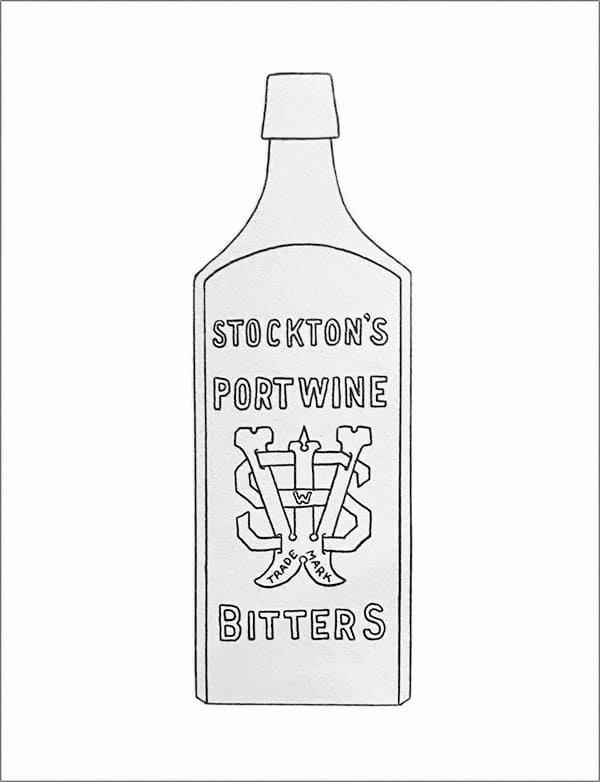
S 198 STOCKTON’S / PORT WINE / motif monogram WWS TRADE ( su ) MARK ( sd ) / BITTERS // f // f // f //
9 1/8 x 3 x 2 ¼ (6 3/8)
Rectangular, Amber, LTC, Applied mouth, Very rare
William W. Stockton & Co., sole proprietor and manufacturer, No. 278 First Street, San Jose, California
The bitters was initially called Stockton’s Celebrated Malvoisie Port Wine Bitters. An original label was included with his trade-mark registration for the brand, deposited with the California Secretary of State as trade-mark Number 971 on April 9, 1883.
See S 198 and p548 in Bitters Bottles
Support: Primary research by Eric McGuire.
Support: Reference to Bitters Bottles and by Carlyn Ring and W. C. Ham. Use of Stockton’s Port Wine Bitters illustration granted by Bill Ham.
Support Images: Stockton’s Port Wine Bitters secondary images from American Bottle Auctions and Peachridge Glass.
Support Images: Auction Lot #20: STOCKTON’S PORT WINE BITTERS. Applied top 1884-86. For some time, many people thought this bottle was put up for a Stockton company and that would include the author. On further inspection, it turns out that it was made for a man named Stockton who was based in San Jose. Our research shows that it was given a trademark starting in 1883. These are an amazing bottle if not just for the elaborate monogram alone. Aside from the monogram on the California Clubhouse Whiskey, we believe this one is about as bold and likable as any we’ve seen. Condition is terrific and grades an 8.5. – Jeff Wichmann, American Bottle Auctions, Auction 70, Part 1 of the Don Dwyer Collection
Join the FOHBC: The Virtual Museum is a project of the Federation of Historical Bottle Collectors (FOHBC). To become a member.