A. Stone & Co. PhilAda.
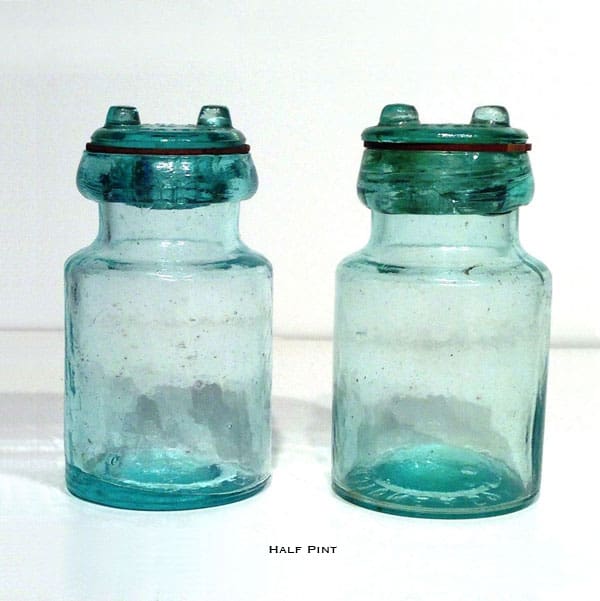
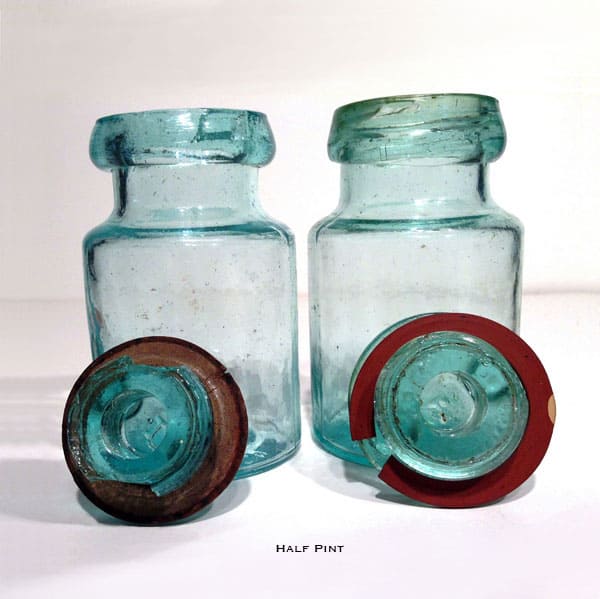
A. Stone & Co. PhilAda.
Wax Sealer Jar
Amasa Stone, Philadelphia, Pennsylvania
Aquamarine Small Mouth Quart
Provenance: Jerry McCann Collection
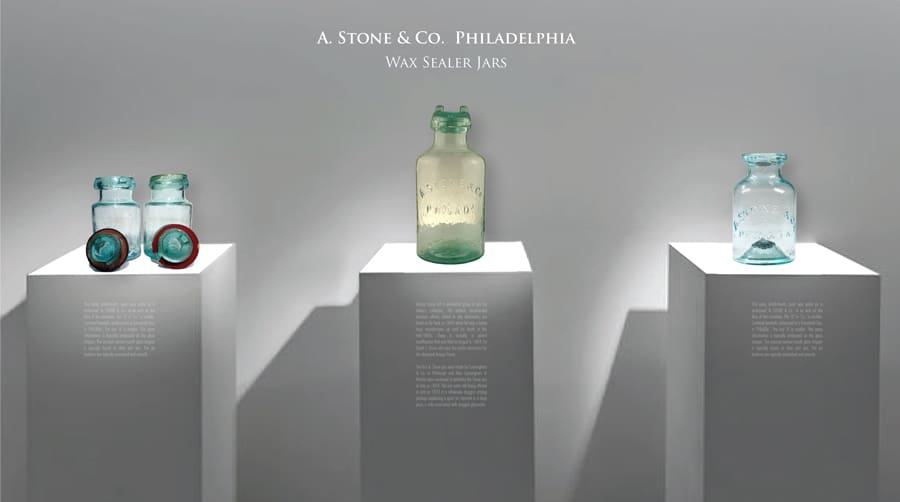
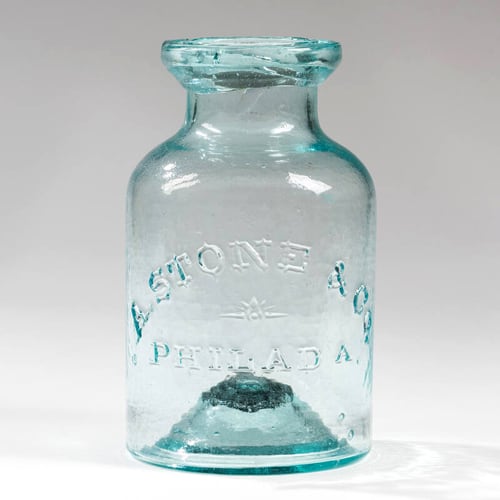
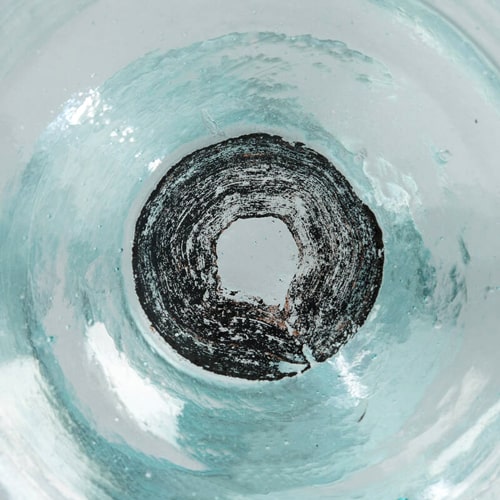
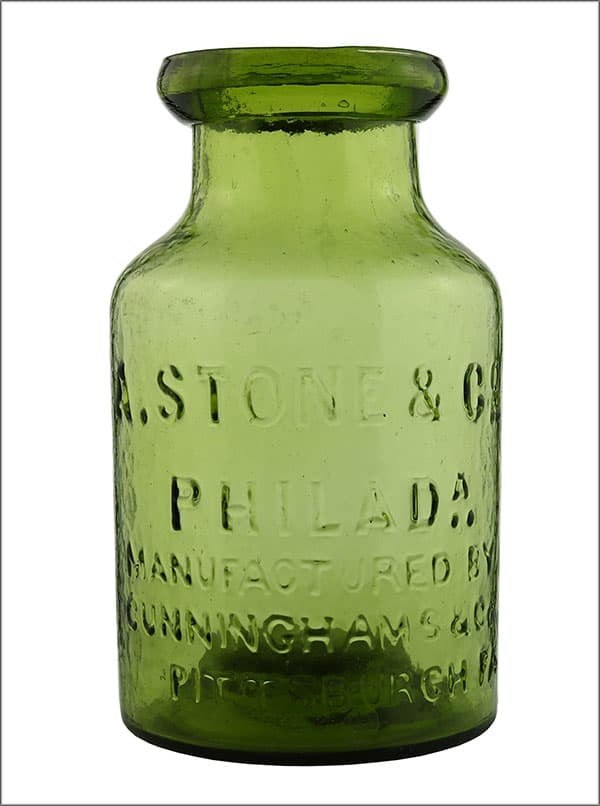
This early, small-mouth, quart wax sealer jar is embossed ‘A. STONE & Co.’ in an arch on the face of the container. The “o” in “Co.” is smaller. Centered beneath, embossed in a horizontal line, is ‘PHILADa’. The last “a” is smaller. This same information is typically embossed on the glass stopper. The unusual narrow mouth glass stopper is typically found on their pint jars. The jar bottoms are typically unmarked and smooth.
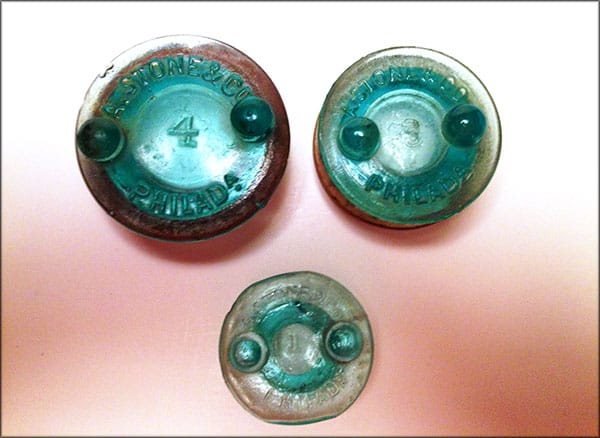
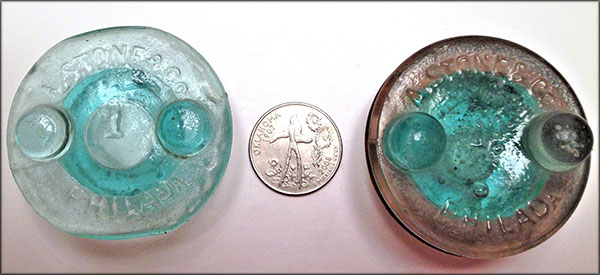
A. Stone & Co. consisted of Amasa Stone and George S. Brown. They were listed as glassware dealers in Philadelphia City Directories from 1857 through 1864.
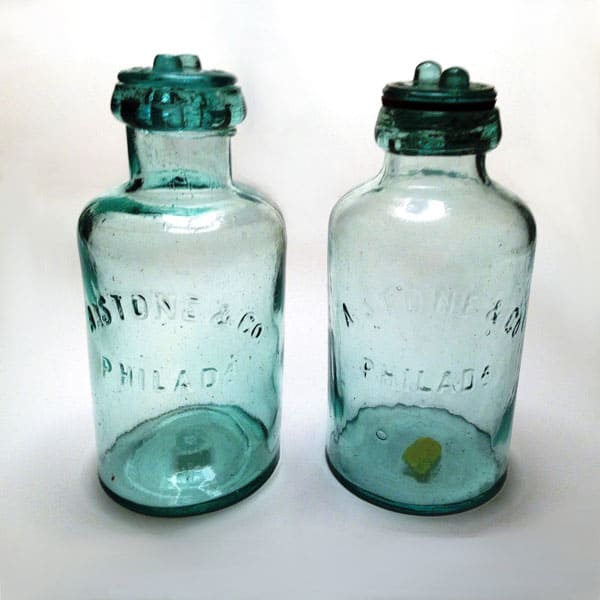
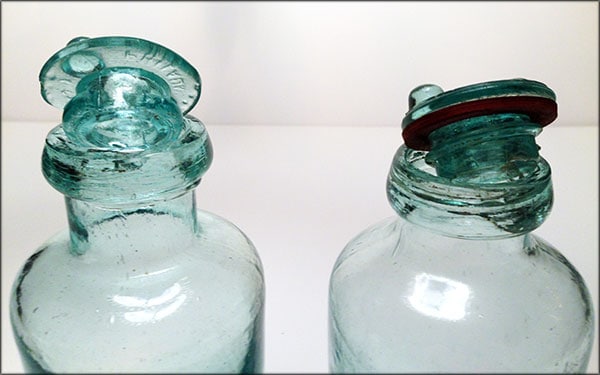
Eventually, most of the molds they used produced jars with either an internal threaded or lug finish that allowed for a glass stopper closure. This meant that for most mold examples it is possible to have three different closure finishes as noted below.
Wax Sealer:
• Closure: Wax seal, grooved ring, and metal cap with a wire clamp.
• Lid: Deep metal cap.
• Note: Jars from the same mold can be found both with pontil scars and with smooth bases.
Threaded Glass Screw Stopper:
• Closure: Top seal, threaded glass lid engaging thread on the inside of jar’s neck.
• Lid: Embossed ‘A. STONE & Co. PHILADa’ (The “a” is raised, smaller, and underlined).
• Note: The glass lid comes in a variety of sizes, forms, and slight embossing variations.
Internal Glass Lug Stopper:
• Closure: Top seal, glass lid with two notches on edge to engage two lugs inside jar’s mouth.
• Lid: Embossed ‘A. STONE & Co. PHILADa’ (The “a” is raised, smaller, and underlined).
• Note: The glass lid comes in a variety of sizes, forms, and slight embossing variations.
Many of the jars are found in a pale aqua glass typical of those produced in South Jersey (just east of Philadelphia across the Delaware River). Those made in Pittsburgh are usually found in bold blue-green aqua glass shades.
When collecting the A. Stone jars, it is possible to put together several dozen jars of various sizes from half-pints to half-gallons, made in a variety of molds with unique embossings and closures. Some color variations are also reported.
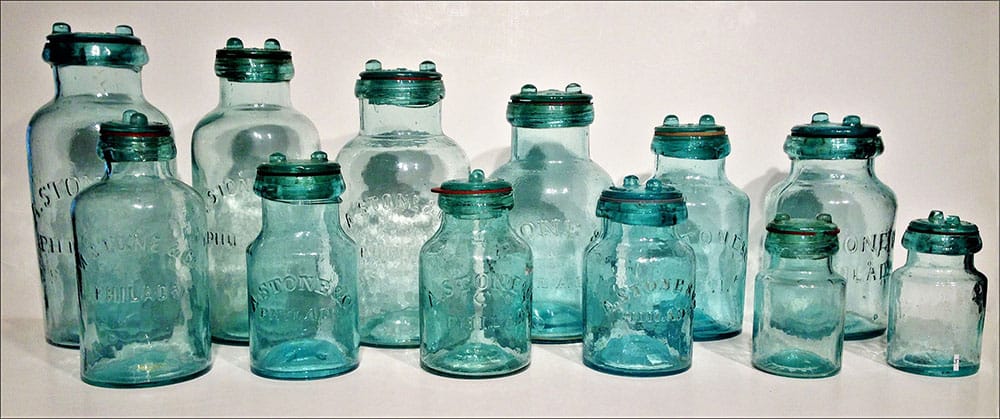
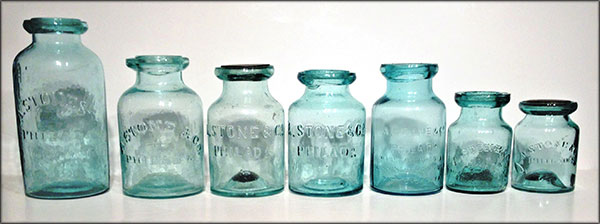
Amasa Stone left a wonderful group of jars for today’s collectors. His earliest documented business efforts, found in city directories, are listed as far back as 1843 when he was a hemp hose manufacturer up until his death in the mid-1860s. There is actually a patent modification that was filed on August 6, 1869, by Sarah T. Stone who was the estate administrator for the deceased Amasa Stone.
The first A. Stone jars were made by Cunningham & Co. in Pittsburgh and then Cunningham & Ihmsen who continued to advertise the Stone jars as late as 1869. The jars were still being offered as late as 1873 in a wholesale druggist catalog perhaps explaining a quart jar reported in a deep puce, a color associated with druggist glassware.
See our museum example of a base-embossed Cunningham & Co. Pittsburgh jar.
See our museum example of an A. Stone & Co. – Cunninghams & Co. jar in olive green.
Some Stone jars have an E. T. Whitehead embossing added, suggesting that this lamp goods dealer (1864 through 1867) may have acquired an interest in the Stone Company after Amasa’s death. E. T. Whitehead produced the most historically important variation embossed “The Great Eastern Philada E.T. Whitehead” celebrating the first successful laying of a transatlantic telegraph cable on July 27, 1866.
See the museum example of The Great Eastern jar.
Primary Image: A. Stone Philadelphia wax sealer jar imaged on location by the FOHBC Virtual Museum midwest studio led by Alan DeMaison.
Support Images: A. Stone & Co. slide images and group photographs from the Jeff Vanaman collection.
Support: Reference to Fruit Jar Annual 2020 – The Guide to Collecting Fruit Jars by Jerome J. McCann
Support: Reference to Red Book #11, the Collector’s Guide to Old Fruit Jars by Douglas M. Leybourne, Jr.
Join the FOHBC: The Virtual Museum is a project of the Federation of Historical Bottle Collectors (FOHBC). To become a member.