Pomona – Patented Mar 10th 1868
Pomona
Patented Mar 10th 1868
Massachusett’s Glass Company, Boston, Mass.
Aquamarine Quart
Provenance: Jerry McCann Collection
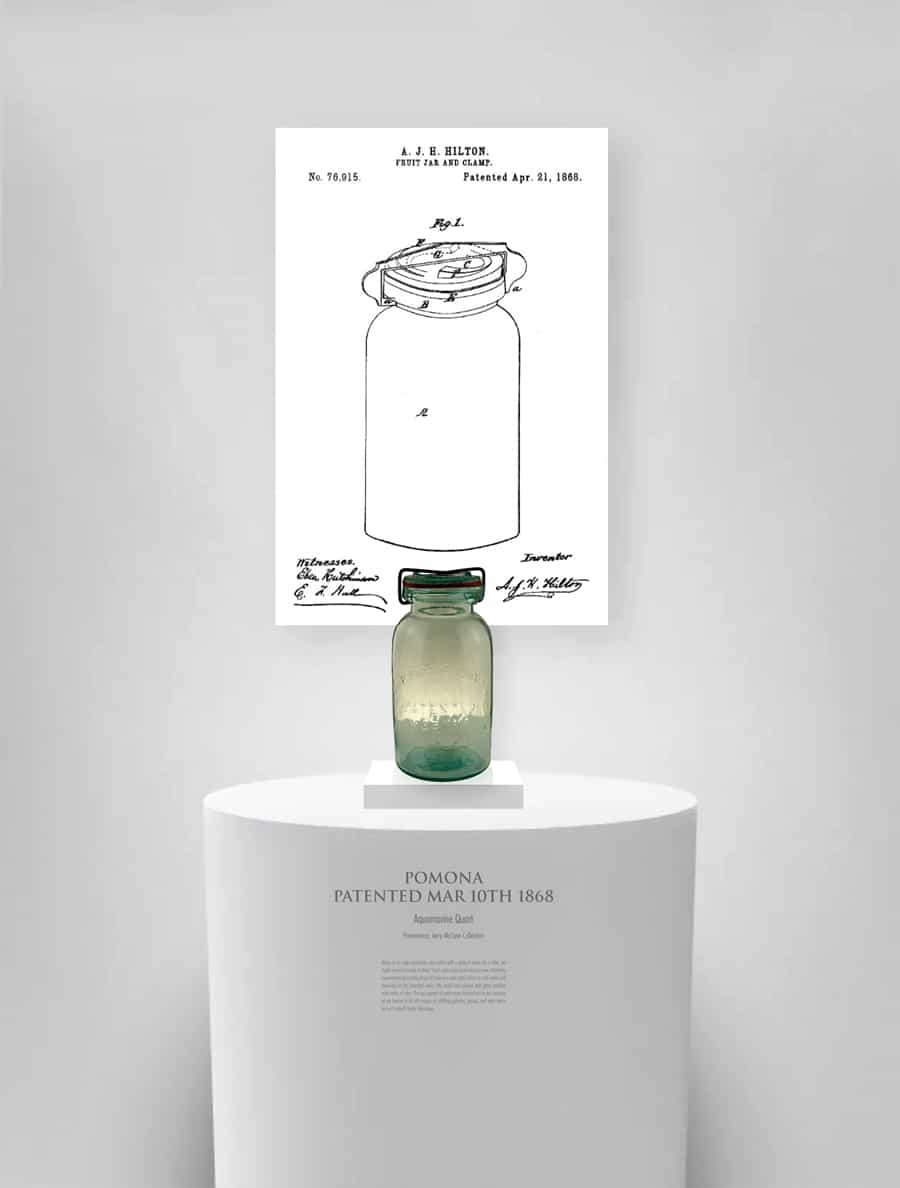
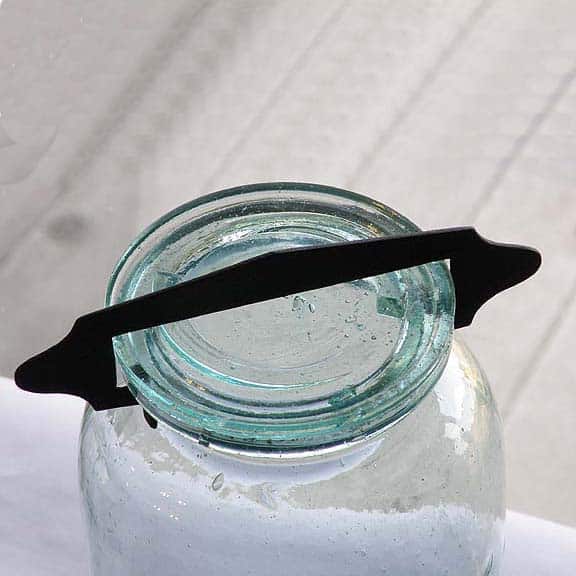
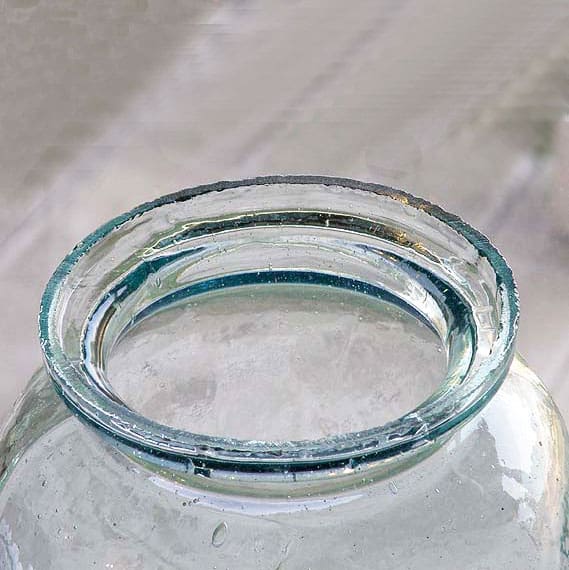
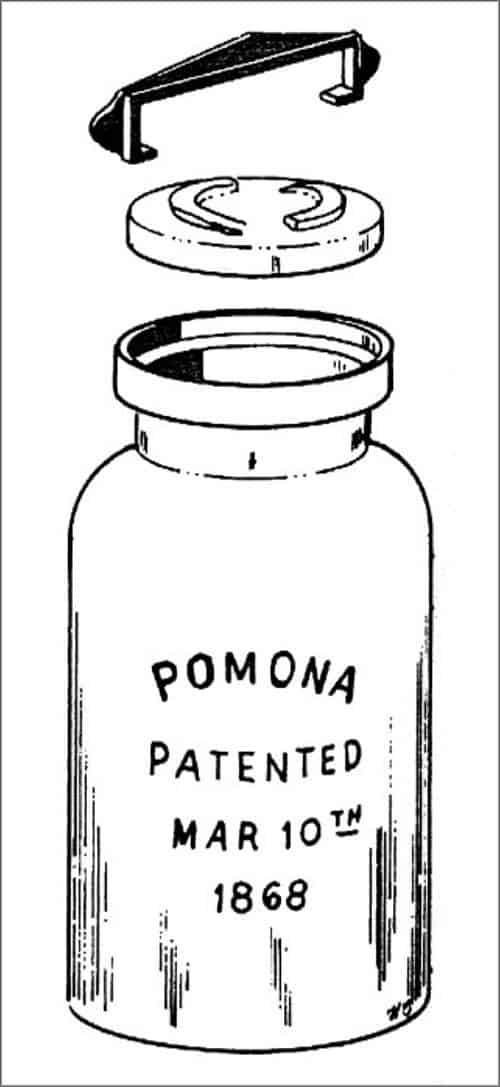
Here is a special jar with an interesting closure. Our museum jar is embossed on the jar face ‘POMONA’ in a slight arch over ‘PATENTED MAR 10TH 1868’. The lid is embossed ‘March 10TH 1868’. Additionally, the base is embossed ‘MASS. GLASS CO.’ The jar is hand blown with a ground lip. The closure is a top seal on a ground lip with a glass lid with two inclined ramps on the top held down by the cast iron, flat yoke clamp hooking under the jar’s finish. The jar is considered extremely rare.
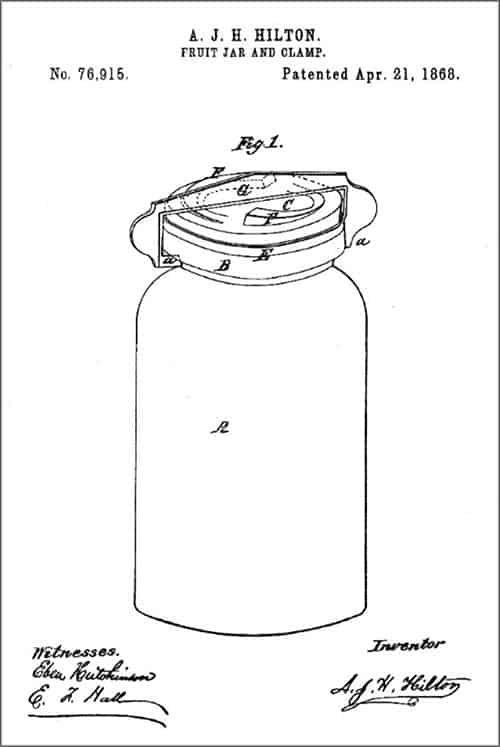
Alexander J. H. Hilton of Boston, Massachusetts was the patentee of the Pomona jar. He received Patent No. 76,915 for a Fruit Jar and Clamp. The patent was received on April 21, 1868, and antedated to March 10, 1868. The jar was made circa 1868 by the Massachusetts Glass Company in Boston.
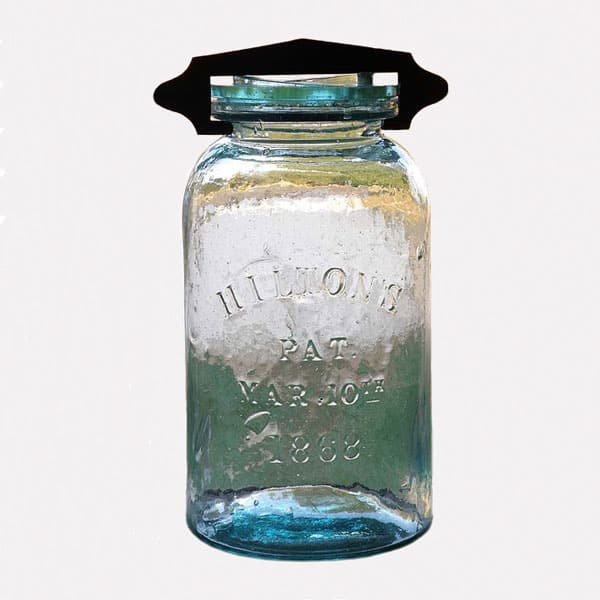
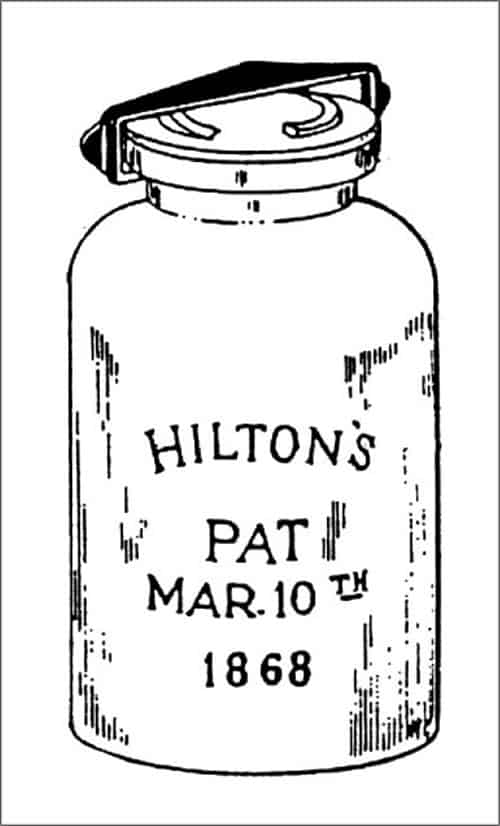
With any discussion of a Pomona jar, we must look at the related Hilton’s Patent Mar 28, 1868 jar which is pictured below and in the support images.
Massachusetts Glass Co.
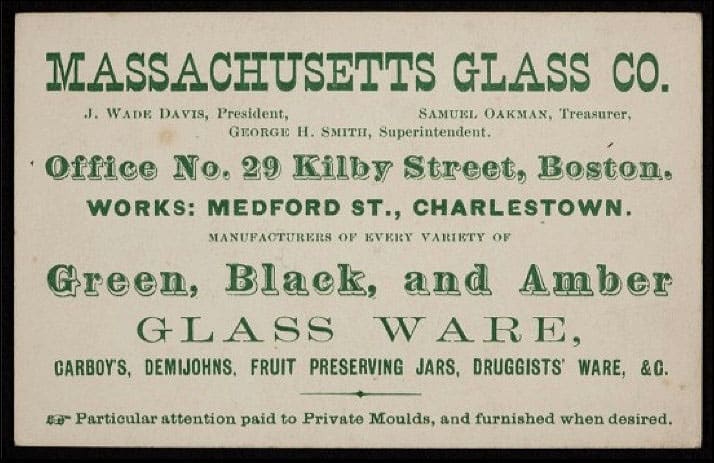
The Massachusetts Glass Co., of Somerville, Massachusetts, was incorporated in 1867. Samuel Oakman, George W. Pinkerton, J. Wade Davis, Joseph H. Orcutt, and George W. Park were the original incorporators, with Oakman as president and Pinkerton as secretary. George H. Smith was the superintendent. The new firm took over the furnaces and tools of the earlier Massachusetts Glass Co., beginning operations on November 1, 1867.
On January 23, 1868, the Boston Herald listed Davis as president, with S. H. Fessenden, J. S. Palmer, and J. P. Gregory as directors. This was a new group. The Boston Journal advertised “Hilton’s Patent All-Glass Fruit Jar . . . No metallic cover to corrode or rust. . . Can be opened with a pin. The most simple and most perfect jar on the market.”
A July 18, 1868, advertisement in the Massachusetts Ploughman and New England Journal of Agriculture illustrated the jar. The Commercial Bulletin presented a cameo description of the factory on April 17, 1869:
The Massachusetts Glass Company, whose works are at Charlestown, has been established about three years . . . 100 hands . . . turning out $150,000 worth, annually, of light green and amber ware, including bottles, demijohns, carboys, fruit jars, &c. The works now have one furnace of 6 pots, but another will soon be added, by which their capacity will be doubled. . . . . Its product is mostly sold to the New England trade. . . . J. W. Davis is president of the company; Samuel Oakman, treasurer, George H. Smith superintendent.
By 1871 or so, the factory was called the Boston Glass Works. The norm for that era was to have a different name for the plant and the operating company. The Boston Herald announced the death knell for the firm on January 16, 1871, when it reported that the Massachusetts Glass Co. “has failed with liabilities at $97,000.” The Gazette put their assets at about $22,000. The firm reorganized as the Boston Bottle Works with Oakman still at the helm. The firm again reorganized as the Bay State Glass Works in 1877, with Oakman still noted as the agent until the company’s last listing in 1879.
Support Images: Lot 4146: HILTONS PATENT 1868 Aqua Quart. Aquamarine. Closure: Original glass lid with sloping ramps (edge chips) and a replica metal clamp (no originals known). Appearance: Sparkling glass. Condition: Normal nicking of the ground mouth. Embossing: Medium to strong. Base: “+” Age: c1870. Availability: Rare – Greg Spurgeon, North American Glass
Primary Image: The Pomona jar imaged on location by Alan DeMaison, FOHBC Virtual Museum Midwest Studio
Support: Reference to Other H Marks by Bill Lockhart Beau Schriever, Carol Serr, and Bill Lindsey
Support: Reference to Other M Marks by Bill Lockhart, Beau Schriever, Bill Lindsey, and Carol Serr with contributions by David Whitten
Support: Reference to Other P Marks by Bill Lockhart, Beau Schriever, Bill Lindsey, and Carol Serr
Support: Reference to Fruit Jar Annual 2020 – The Guide to Collecting Fruit Jars by Jerome J. McCann
Support: Reference to Red Book #11, the Collector’s Guide to Old Fruit Jars by Douglas M. Leybourne, Jr. Use of Creswick illustrations courtesy Leybourne.
Join the FOHBC: The Virtual Museum is a project of the Federation of Historical Bottle Collectors (FOHBC). To become a member.