GV-6 • “Success To The Railroad” and Horse and Cart Historical Flask
GV – 6
“Success To The Railroad” and Horse and Cart
Historical Flask
Coventry Glass Works, Coventry, Connecticut
Bright Yellow Amber with an Olive Tone Pint
Provenance: Chris Bubash Collection
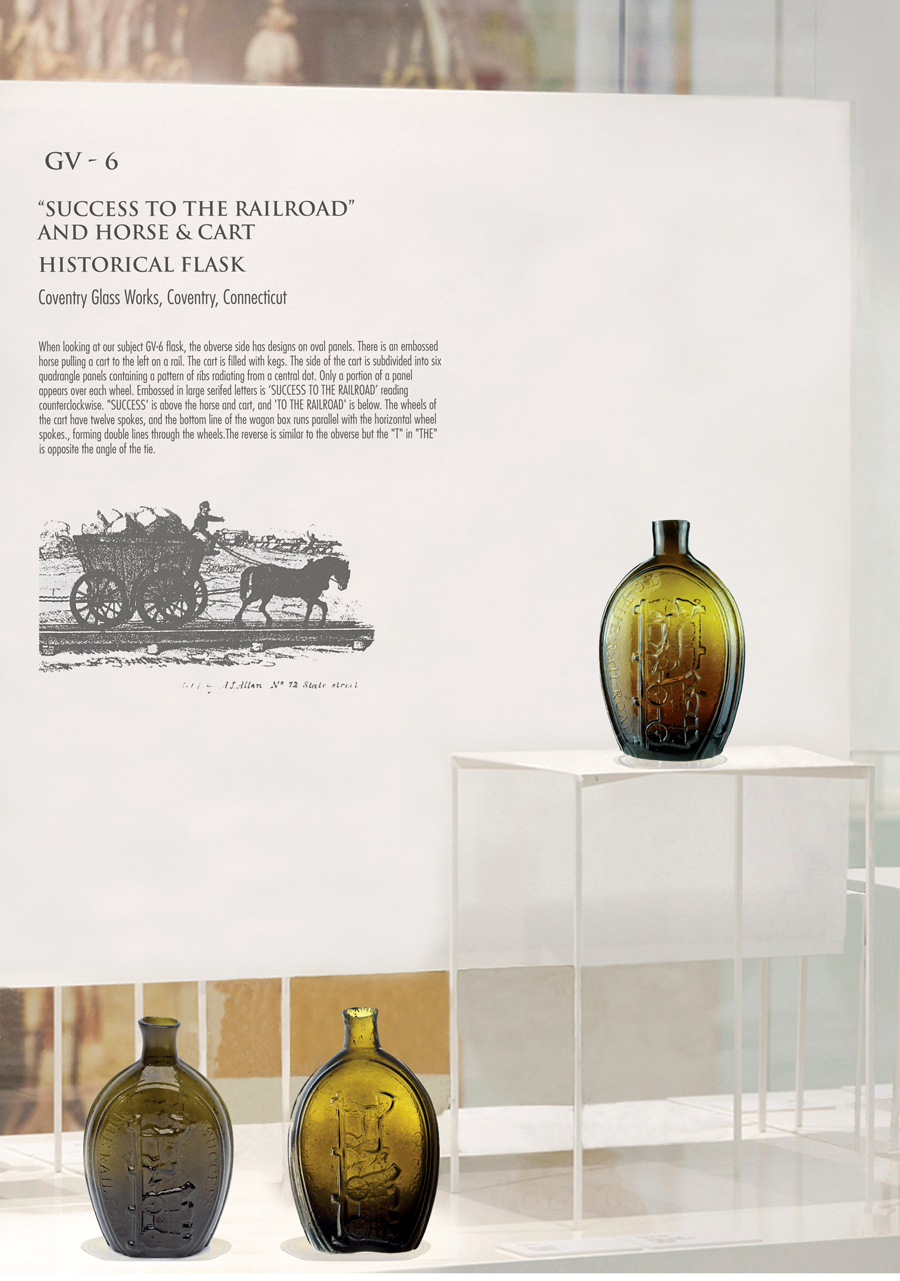
While the “Success to the Railroad” GV-2 flask in our museum pictures a “steam locomotive,” this museum example of a GV-6 pint “Success to the Railroad” flask features a “horse and cart railroad” on both sides. During the throes of the Industrial Revolution, there were horses pulling carts on rails as the Baltimore & Ohio Railroad ran on horsepower. Eventually, steam would win over and transportation would be changed forever.
The railroad or railway, both the horse-and-cart type and the steam locomotive, inspired many early American flask designs. Of the fourteen railroad flasks charted, the slogan “Success to the Railroad” appears on seven.
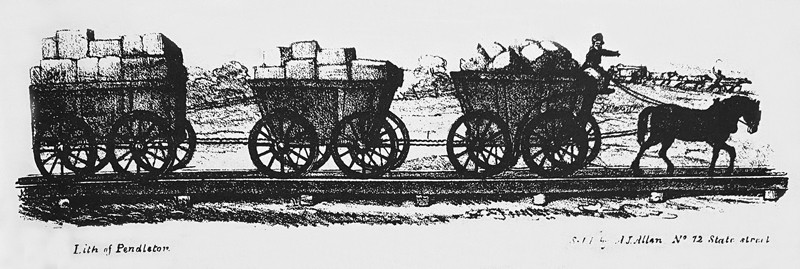
The illustration segment above is from David C. Johnson’s lithograph of the “Granite Railway” operating out of Quincy, Massachusetts. The railway, which opened on October 7, 1826, was the first in the United States. Horse-drawn carts carried the granite block for the Bunker Hill Monument 2 ¾ miles from the quarry to Neponset River.
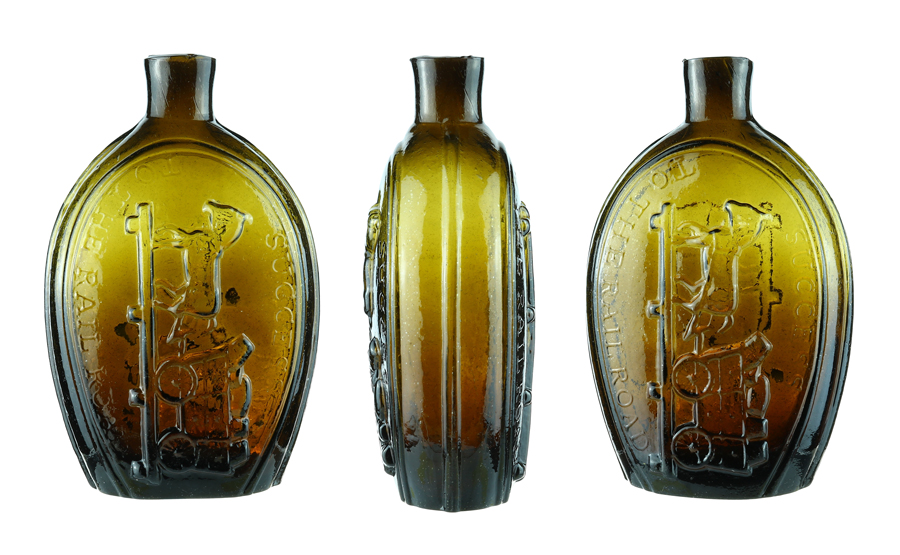
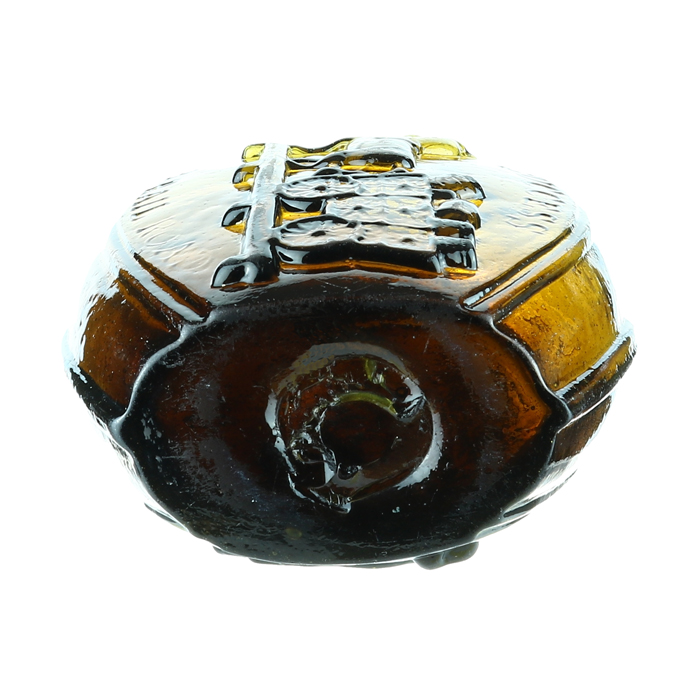
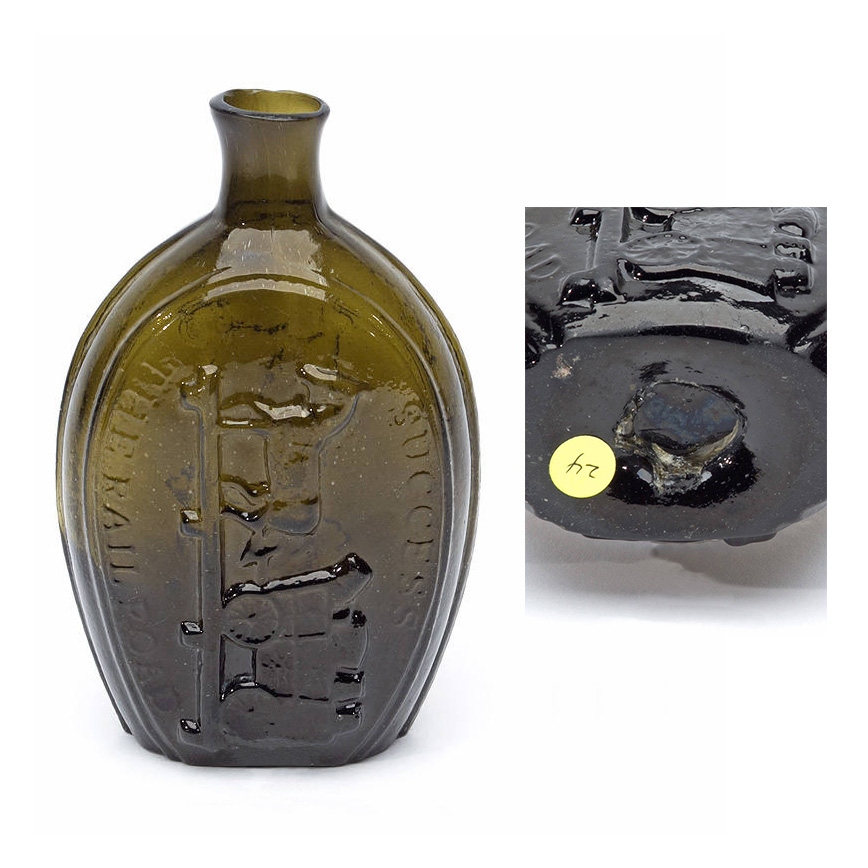
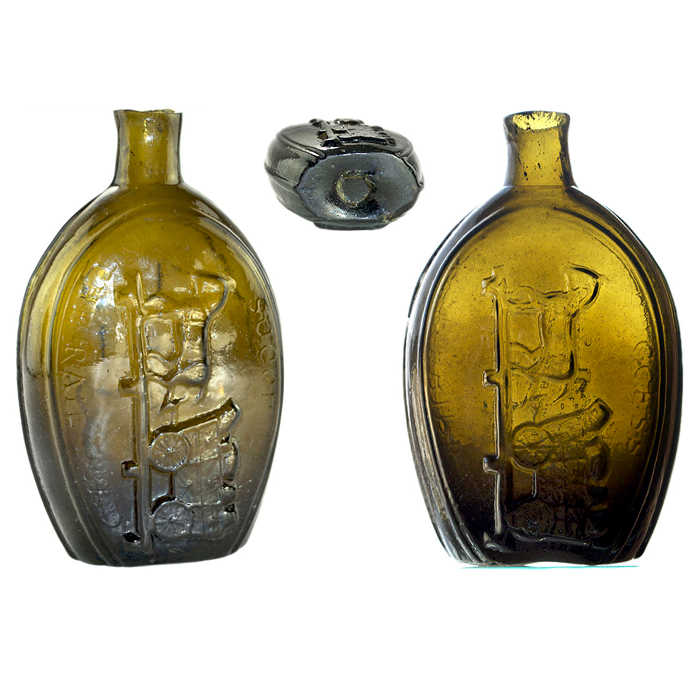
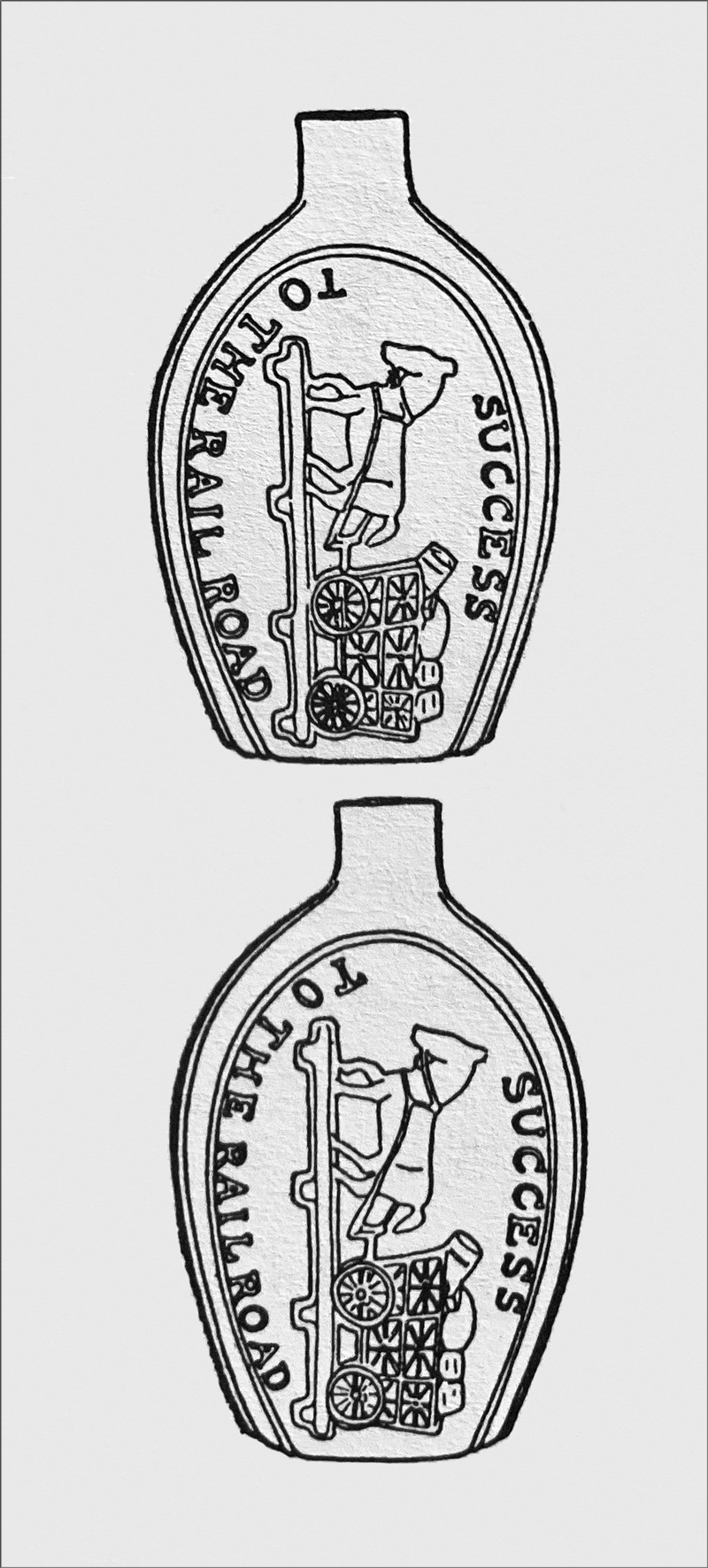
When looking at our subject GV-6 flask, the obverse side has designs on oval panels. There is an embossed horse pulling a cart to the left on a rail. The cart is filled with kegs. The side of the cart is subdivided into six quadrangle panels containing a pattern of ribs radiating from a central dot. Only a portion of a panel appears over each wheel. Embossed in serifed letters is ‘SUCCESS TO THE RAILROAD’ reading counterclockwise. ‘SUCCESS’ is above the horse and cart, and ‘TO THE RAILROAD’ is below. The wheels of the cart have twelve spokes, and the bottom line of the wagon box runs parallel with the horizontal wheel spokes, forming double lines through the wheels. The reverse is similar to the obverse, but the ‘T’ in “THE’ is opposite the angle of the tie.
The flask has a plain lip and pontil mark. The edges are vertically ribbed with a heavy medial rib. Known colors are clear-amber, olive amber, olive green, golden amber and yellow amber. The pint was made at the Coventry Glass Works in Coventry, Connecticut.
Coventry Glass Works
Seven men agreed to erect a glass factory in Coventry, Connecticut, on January 14, 1813, along the Willimantic River. Four men, Captain Nathaniel Root, Ebenezer Root Nathaniel Root Jr., and Joseph A. Norton, all Coventry, were not glassmakers. The other three included Eli Evans, Thomas W. Bishop, and Uriah Andrews, glassblowers from East Hartford who had the experience running the day-to-day operations. Eli, Thomas, and Uriah were to use their expertise where needed in the glass factory and be compensated at $26 per month and $45 for each year they worked in the plant.
In 1816, there was an agreement to expand by adding buildings. Thomas Stubbins was operating the glassworks by 1820. Lafayette flasks having embossed “T.S.” were made sometime around 1825. The brother of Thomas may have entered the business sometime in 1825. The “S.S.” on some Lafayette flasks could be the entry of a brother to the glassworks or possibly a mistake. Later in 1825, Rufus B. Chamberlain joined the firm, and they were now Stebbins & Chamberlin. The “S & C” is found on some flasks. In 1828, Jasper Gilbert, John Turner, and Rufus B. Chamberlain, with John Turner’s brother Levi took control, forming Gilbert Turner & Company. Lack of wood is said to be the reason for the glassworks closing in 1848, but accounting books seem to indicate sales into 1849.
See the museum example of a GV-4 Success to the Railroad flask.
See the museum example of a GV-5 Success to the Railroad flask.
Primary Image: The GV-6 Success to the Railroad flask imaged on location by Alan DeMaison, FOHBC Virtual Museum Midwest Studio.
Support: Reference to American Bottles and Flasks and Their Ancestry by Helen McKearin and Kenneth M. Wilson, Crown Publishers, New York, 1978.
Support Image: Auction Lot 73: “Success To The Railroad” And Horse And Cart Historical Flask, Coventry Glass Works, Coventry, Connecticut, 1830-1848. Deep yellowish olive, sheared mouth – pontil scar, pint; (exterior high point wear mostly on one side). GV-6 A handsome flask with numerous small bubbles. Fine condition. – Norman Heckler Jr. & Sr., Norman C. Heckler & Company, Auction #148
Support Image: Auction Lot 90: (museum Example) “Success To The Railroad” And Horse And Cart Historical Flask, Coventry Glass Works, Coventry, Connecticut, 1830-1848. Bright yellow amber with an olive tone, sheared mouth – pontil scar, pint; (light exterior high point wear, 1/8 inch chip from the mouth edge). GV-6 Strong mold impression and attractive bright color. – Norman Heckler Jr. & Sr., Norman C. Heckler & Company, Auction #148
Support Image: Auction Lot 149: “SUCCESS TO THE RAILROAD” – HORSE PULLING A CART – (the reverse is identical), (GV-6), Coventry Glass Works, Coventry, Connecticut, ca. 1825 – 1835, deep yellowish ‘old’ amber pint, open pontil, sheared and tooled lip. Some very slight spotty wear, otherwise perfect. Ed Cleaveland Collection. – Jim Hagenbuch, Glass Works Auctions, February 2020
Support Image: David C. Johnson’s lithograph of the “Granite Railway” – The American Antiquarian Society, Worcester, Massachusetts.
Support: Reference to Coventry Glass Works by Bill Lockhart, Beau Schriever, Bill Lindsey, and Carol Serr.
Support: Reference to The Coventry Glassworks 1815-1848, The Museum of Connecticut Glass
Support: Reference to Success to the Railroad – The Baltimore & Ohio Railroad Museum
Join the FOHBC: The Virtual Museum is a project of the Federation of Historical Bottle Collectors (FOHBC). To become a member.