Mason’s Patent Nov. 30th 1858 Albany Aniline & Chemical Works Rumpff & Lutz New York Sole Agents
Mason’s Patent Nov. 30th 1858
Albany Aniline & Chemical Works
Rumpff & Lutz New York Sole Agents
Albany Aniline & Chemical Works, Albany, New York
Aquamarine Midget Pint
Provenance: Phil Smith Collection
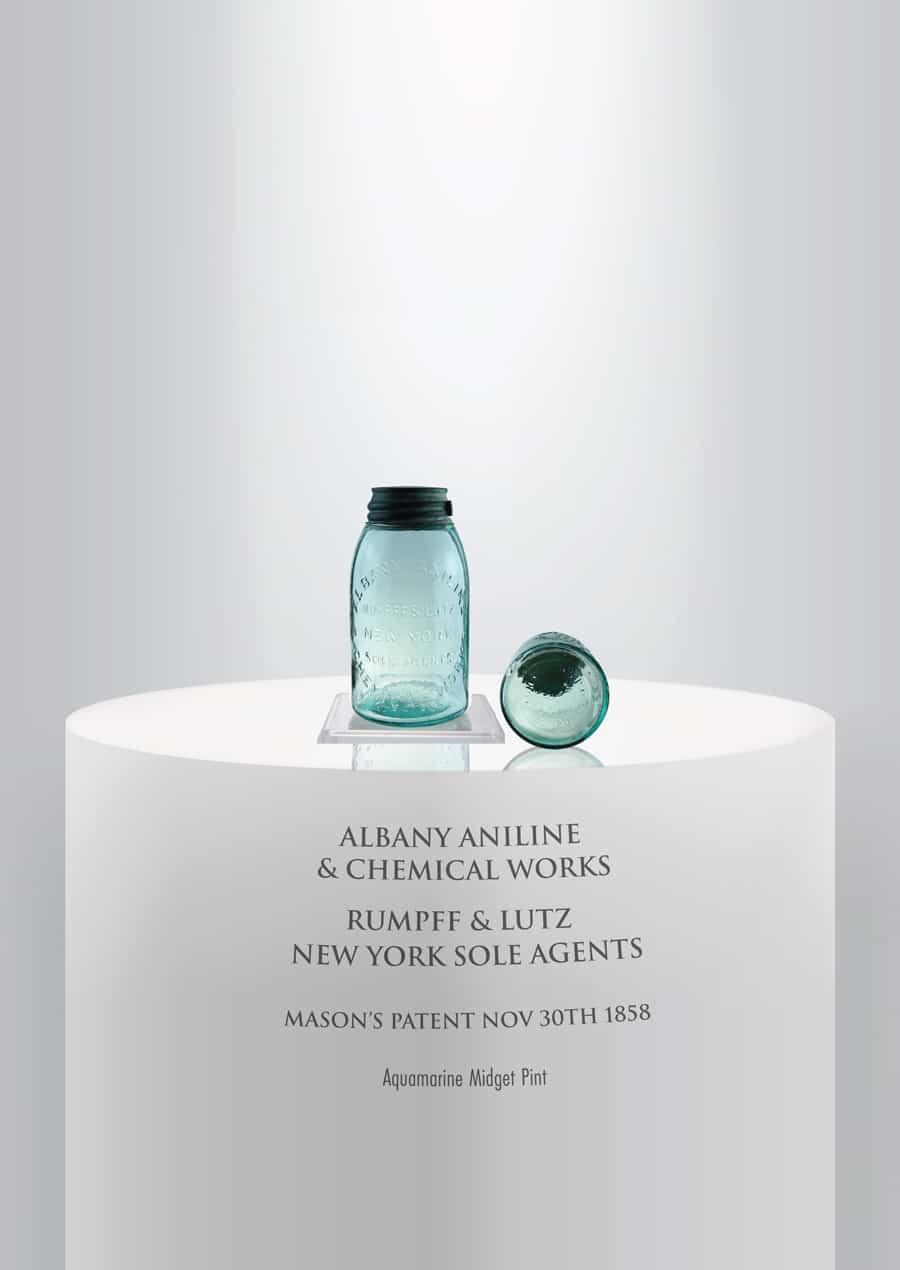
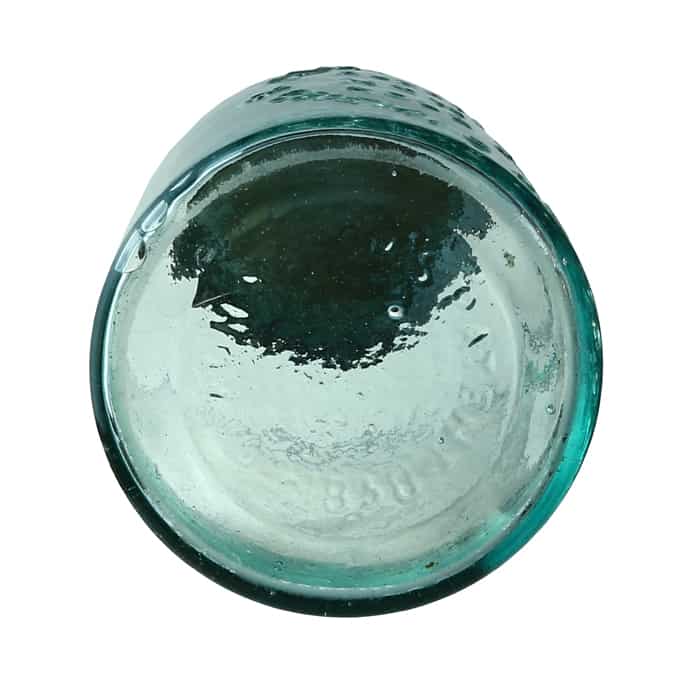
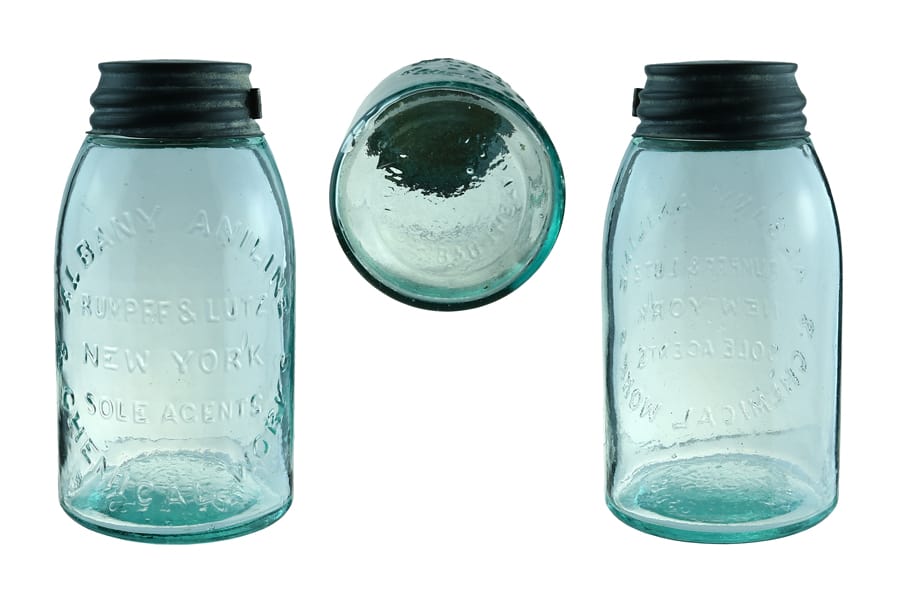
Our extremely rare early product jar is base-embossed “Mason’s Patent Nov. 30th 1858.” The midget pint cylindrical aquamarine jar has an abundance of embossed copy on the side of the jar reading ‘ALBANY ANILINE & CHEMICAL WORKS’ in joined convex and concave arches creating a circle using sans serif copy. Within the circle are three lines of horizontal sans serif copy reading ‘RUMPFF & LUTZ’ (1st line), ‘NEW YORK’ (2nd line), and ‘SOLE AGENTS’ (3rd line). The base embossed copy is very faint.
Albany Aniline & Chemical Works
Albany Aniline & Chemical Works started on Hamilton Street in Albany, New York, in 1868, when cardboard maker A. Bott branched out into colorants and formed the company.
Aniline, a toxic aromatic amine, was a widely used industrial chemical, particularly in manufacturing dyes, resins, varnishes, perfumes, pigments, herbicides, fungicides, explosives, isocyanates, hydroquinones, and rubber chemicals.
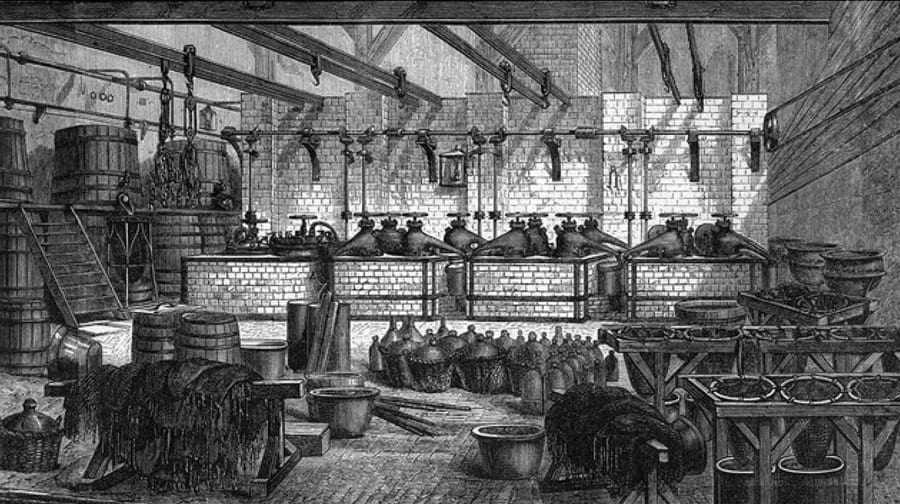
Dyes, mostly made from coal tars and other more nefarious substances, weren’t entirely compatible with residential areas of the town, especially if you are looking at water tables, so the plant was moved to a location on Broadway. Bott left the concern, and other Albany names like Hendrick and Pruyn took over. A connection to German dye-maker Farbenfabriken of Elberfeld was established as the company got into the magenta business, which was popular then. A couple of imported chemists, William Loesser and Hermann Preiss, had a falling out with manager Elwood Hendrick and, with the support of Farbenfabriken. On March 2, 1885, the following was reported in regional newspapers.
A BIG FIRE. A Loss of Over $200,000 Caused by the Burning of a Freight-House at Albany, N.Y The most destructive fire that has occurred in this city for years broke out yesterday in the eastern end of a huge frame freight house belonging to the Albany & Susquehanna Railroad Company, used also by the West Shore Road. The mains were of insufficient size to furnish a good supply of water, and it was at one time feared that the whole southern part of the city would be swept by the flames, which spread with terrible rapidity. A high wind blew for some time after the flames burst forth, but the gale died away and was followed by a heavy rainfall, which helped quench the fire and undoubtedly saved much property. The depot was six hundred feet long and contained, besides a large amount of stored freight, a number of loaded cars. The depot and contents, with fifteen cars, were destroyed, about forty other cars being damaged. The Albany Aniline and Chemical Works adjoining were also nearly destroyed. The Delaware & Hudson Canal Company owned most of the cars and the West Shore most of the freight. Each of these companies lose (sic) $50,000, the Aniline Company’s loss being about $125,000. It is not known how the fire originated. The burned district embraces several acres. The factory was rebuilt.
Friedrich Bayer and Company
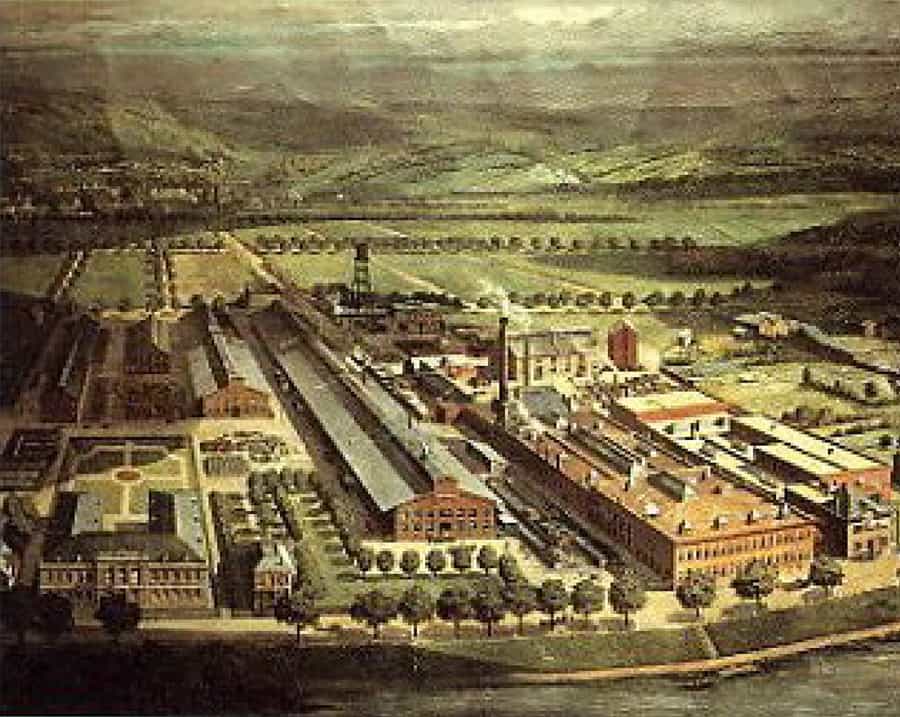
Friedrich Bayer and Company formed the Hudson River Aniline Color Works in 1882 on a site across the Hudson River in Greenbush (now Rensselaer). Hudson River Aniline made fuchsine (magenta dye) and water blues. In agreement with Bayer, the line expanded to alkali and cotton (acid) blues, then continued to grow.
In the first part of the 20th century, the plant expanded greatly, and in 1905 new buildings were dedicated to the manufacture of aspirin, for which Bayer today is most famous. In 1910, the company’s name was changed to Farbenfabriken of Elberfeld Co. In 1913, the company name was changed to The Bayer Co. When the United States entered World War 1 in 1917, the company was seized as alien property and sold to the patent medicine company Sterling Products, which wanted the pharmaceuticals. The dyestuff part of the plant was sold to Cleveland’s Grasselli around 1928. The facility eventually was named General Aniline and Film Corp., better known as GAF, and in 1978 was bought by BASF, “Badische Anilin & Sodafabrik,” another German company.
Rumpff & Lutz
Rumpff & Lutz were importers and manufacturers of Aniline Colors and dyestuffs, colors for paper-hangers, and stainers. Circa 1870 advertising stated that they provided reliable recipes for dying and printing on silk, wool, and cotton. All technology was coming via Europe. They were addressed at 42 Beaver Street in New York City, N.Y.
Primary Image: Mason’s Patent Nov. 30th 1858, Albany Abiline & Chemical Works jar imaged on location by Alan DeMaison, FOHBC Virtual Museum Midwest Studio.
Support: Reference to a 1994 paper by Leander Ricard, posted at ColorantsHistory.org, which gives the history of the dye industry in Rensselaer.
Support: Aniline, a toxic aromatic amine, is a widely used industrial chemical, particularly in the manufacture of dyes, resins, varnishes, perfumes, pigments, herbicides, fungicides, explosives, isocyanates, hydroquinones, and rubber chemicals. – Encyclopedia of Environmental Health
Support: Reference to Fruit Jar Annual 2020 – The Guide to Collecting Fruit Jars by Jerome J. McCann
Support: Reference to Red Book #11, the Collector’s Guide to Old Fruit Jars by Douglas M. Leybourne, Jr.
Join the FOHBC: The Virtual Museum is a project of the Federation of Historical Bottle Collectors (FOHBC). To become a member.