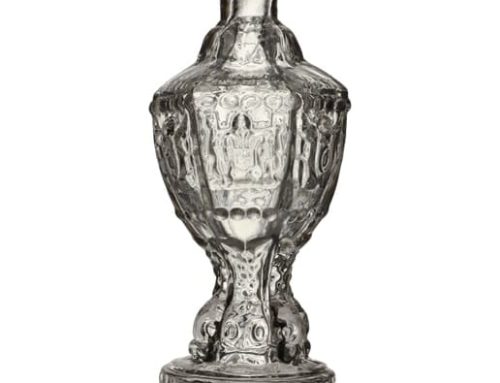
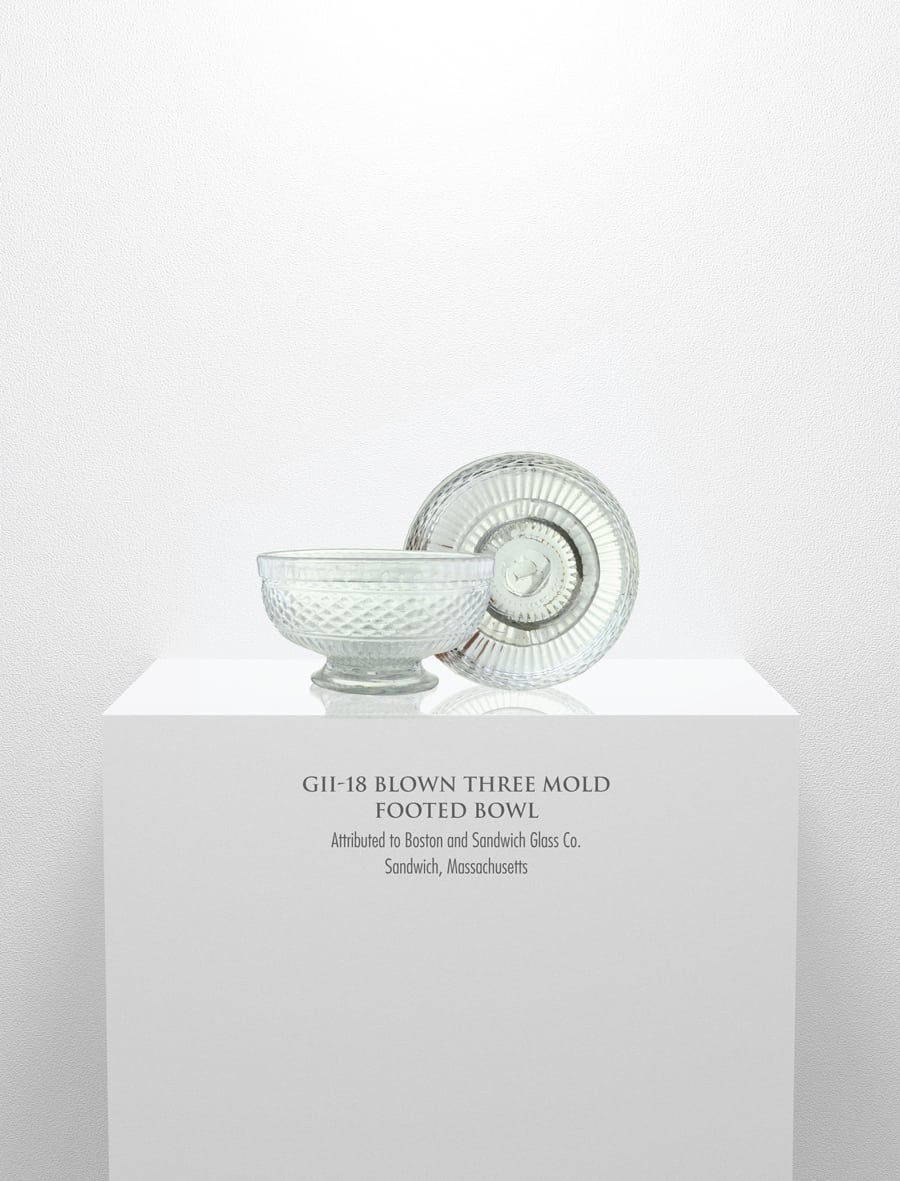
GII-18 Sandwich Footed Bowl
Blown Three Mold
Footed Bowl
GII – 18
Attributed to Boston and Sandwich Glass Co.
Sandwich, Massachusetts
Clear or Colorless Tableware
Provenance: ex Richard S. Ciralli and Mark Vuono Collections
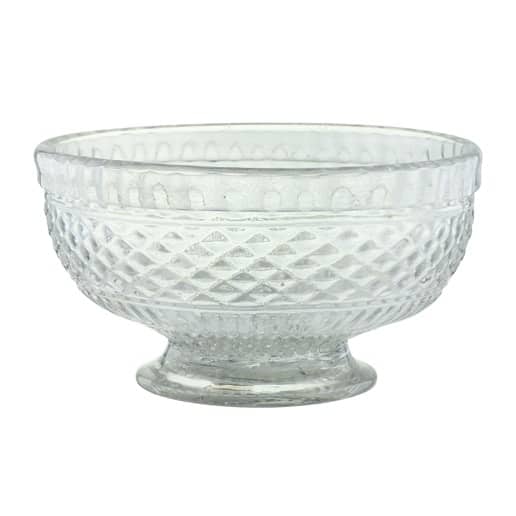
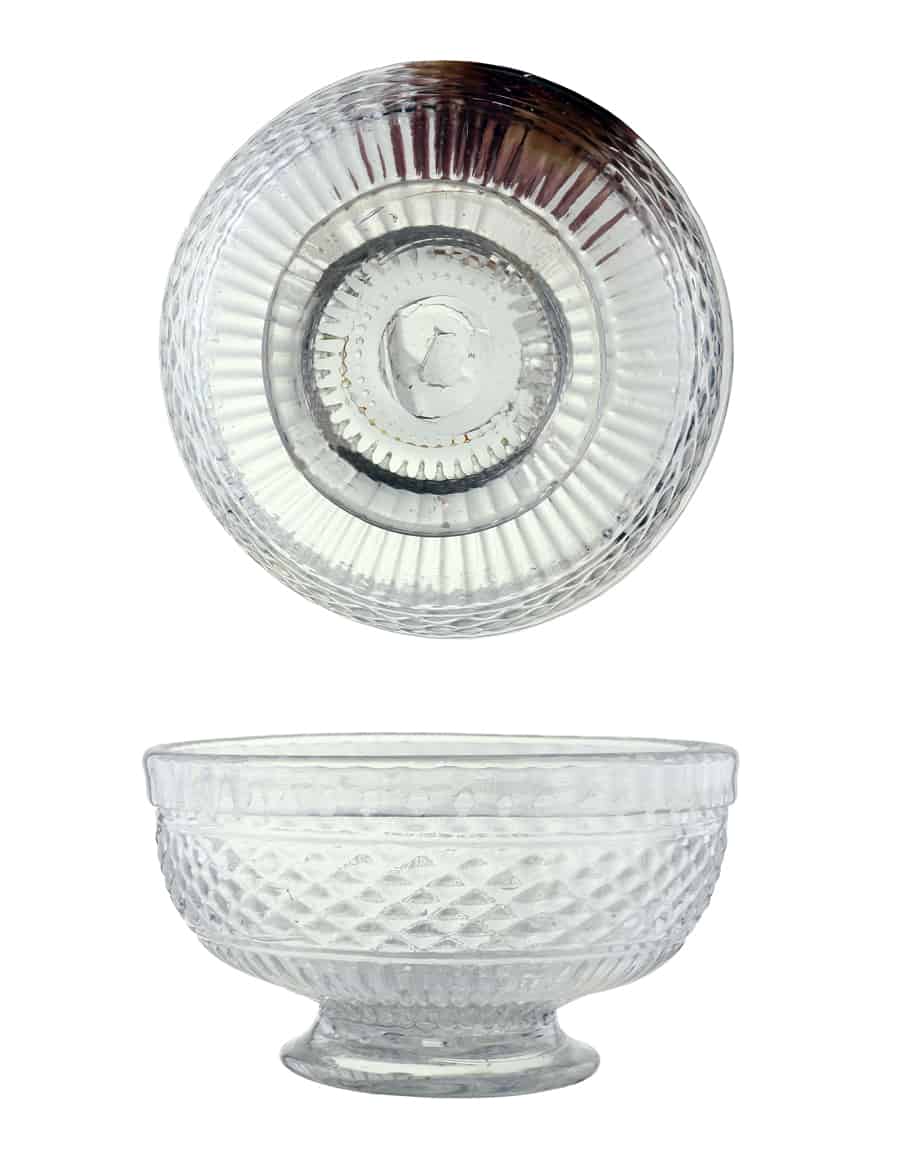
Our museum example represents a GII-18 blown three mold geometric deep footed bowl that is very rare in shape. The measurements are approximately 3 inches tall by 5 1/2 inches top diameter and 2 1/2 inches base diameter. The glass is clear or colorless, and the base is round and pontiled with a similar geometric pattern. The bowl is attributed to the Boston and Sandwich Glass Co. in Sandwich, Massachusetts, circa 1825 to 1835.
The town of Sandwich was settled in 1637 and incorporated in 1639 and is the oldest town on Cape Cod. Initially settled by the English, Sandwich became an agricultural community, with its main export of timber sent back to England. It remained a primarily agricultural community, supplemented by coastal fishing during the American Revolution.
In 1825, the landscape of Sandwich would drastically change because of Deming Jarves, a Boston businessman and former agent of the New England Glass Company of East Cambridge, Massachusetts.
Read Yours Truly, D. Jarves–A Glassmaker’s Gifts by Elizabeth and Frank Creech, FOHBC Bottles and Extras, March–April 2014
Read Another Look at Sandwich Glass by Eric McGuire, FOHBC Bottles and Extras, November–December 2017
Deming Jarves did not choose Sandwich as a site for the glass factory because of the readily available beach sand, which is too impure to make glass that needs silica. The company shipped in pure silica supplies first from New Jersey and New York and later from the Berkshire Hills in western Massachusetts. Jarves also chose Sandwich because of its proximity to a shallow harbor and the possibility of a canal being built through Cape Cod to allow for the shipment of goods. The local availability of timber could be used to fuel the glass furnaces. Even the salt marsh hay and grasses could be used for packing material.
Jarves brought master glassblowers with him from the New England Glass Company. He also recruited workers from England and Ireland. English and Irish glassmakers were considered the foremost craftsmen during the early 19th century. They were very skilled in making blown glassware with high lead content, the most desirable of the period.
The glass company also produced mold-blown wares like our footed bowl. Many of these designs mimicked English and Irish cut glass patterns, but mold-blown pieces were more easily made and required less skilled labor.
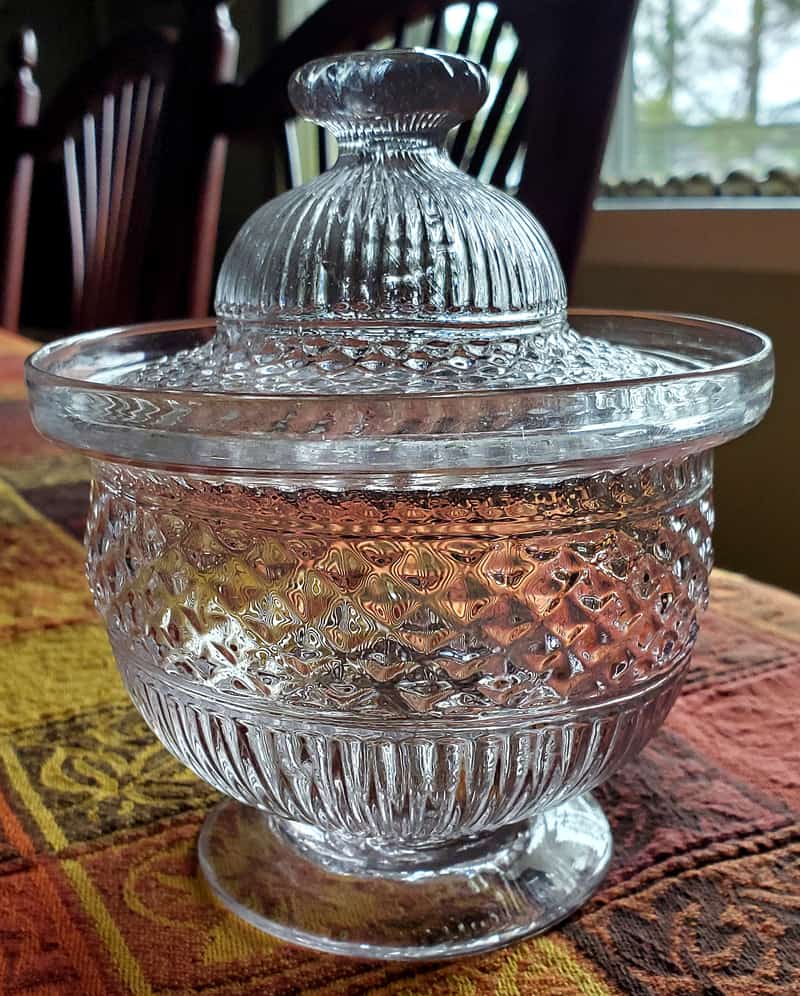
Primary Image: Blown Three Mold GII-18 Footed Bowl imaged on location by Alan DeMaison, FOHBC Virtual Museum Midwest Studio
Support: Reference to Sandwich Glass Museum website
Support: Reference to American Glass by George S. and Helen McKearin, Crown Publishers Inc., New York, 1989.
Support: Reference to American Bottles and Flasks and Their Ancestry by Helen McKearin and Kenneth M. Wilson, Crown Publishers, New York, 1978.
Support Image: GII-18 Blown Three Mold Sugar Bowl. A rare and highly elegant piece of Early American tableware that should be considered as a “museum quality” object! This is a blown three-mold sugar bowl with a matching lid. Probably produced at the Keene NH or Boston & Sandwich Glass Works, 1815-1825, this delicate beauty is perfect, and with the proper provenance, ex. William Elsholz, Volume 1, lot 77. It sold for $5,000 + premium in 1986… 33 years ago! This lovely footed bowl has a galleried rim and a perfectly fitted blown three mold (matching) lid. The piece is like a shimmering jewel, with a lead glass ring that goes on forever. – Bottle Show, Michael George
Support Image: Auction Lot #109: Blown-Molded GII-18 Flip Glass, Slightly tapered form, Diamond-type XIII base with a rough pontil mark. Colorless, Attribution: Boston & Sandwich Glass Co., Circa: 1825-1835. Undamaged. Size: 5 3/4″ H, 4 3/8″ D rim. Provenance: From the estate collection of Wagner P. Thielens, NYC. Literature: Parallels Barlow/Kaiser – The Glass Industry in Sandwich, Vol. 1, p. 224, fig. 1301. – Jeffrey Evans, Jeffrey S. Evans & Assoc., May 25, 2018
Support Image: Auction Lot 247: Blown Three Mold Decanter, Boston and Sandwich Glass Works, Sandwich, Massachusetts, 1820-1840. Bulbous with three applied neck rings, colorless, tooled flared mouth with type 24 stopper – pontil scar, quart. GII-18 A crude decanter with profuse surface swirls and thick glass. Fine condition. – Norman Heckler Jr. & Sr., Norman C. Heckler & Company, Auction #195
Support Image: Auction Lot #159: Blown Molded GII-18 Footed Open Salt. Shallow form raised on a wide drawn foot with a Diamond Type XI base and rough pontil mark. Colorless. Attribution: Boston & Sandwich Glass Co. Circa: 1825-1835. Condition: Undamaged with moderate overall wear. Size: 2″ H, 2 1/2″ D rim, 2″ D base. Provenance: Property from a Minnesota collector. Reference 1: Literature: The McKearins – American Glass, p. 251, GII-18, – Jeffrey Evans, Jeffrey S. Evans & Assoc., Jan 26, 2018
Support Image: Auction Lot #395: Blown-Molded GII-18 Toy Jug, Bulbous body with a sheared rim, pinched and pulled spout, and an applied solid handle with a protruding terminal crimp and curl, raised on a wide thick foot with a 16-diamond base and rough pontil mark. Color: colorless. Attribution: Boston & Sandwich Glass Co. Circa: 1825-1835. Condition: Proof. Size: Height: 2 1/4 in.; foot diameter: 1 5/8 in. Provenance: From the collection of Ken Lyon. – Jeffrey Evans, Jeffrey S. Evans & Assoc., May 22, 2010
Support Image: Auction Lot #113: Blown-Molded GII-18 Quart Decanter. Prussian form with three applied neck rings, and Diamond Type XII base with rough pontil mark, Type 26 stopper. Color: colorless. Attribution: Boston & Sandwich Glass Co. Circa: 1825-1835. Condition: Decanter undamaged, stopper with a single flake to the top. Size: 10 1/4″ HOA, 8 1/4″ H decanter. Provenance: From a private Pennsylvania collection. Reference 1: Literature: The McKearins – American Glass, p. 251, GII-18. Sold Date: May 25, 2018
Join the FOHBC: The Virtual Museum is a project of the Federation of Historical Bottle Collectors (FOHBC). To become a member.