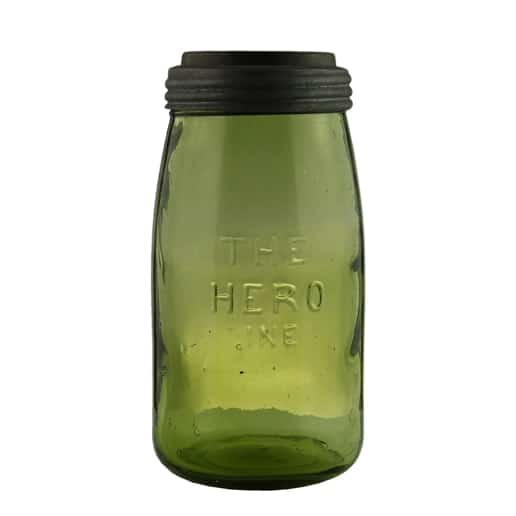
The Hero Ine
The Hero Ine
Patd Nov. 26 1867
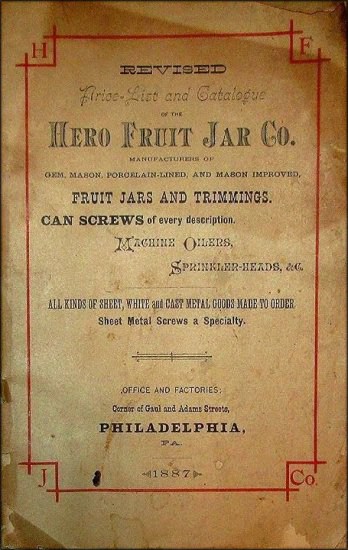
The Hero Fruit Jar Company, Philadelphia, Pennsylvania
Yellow-Olive Quart
Provenance: Jerry McCann Collection
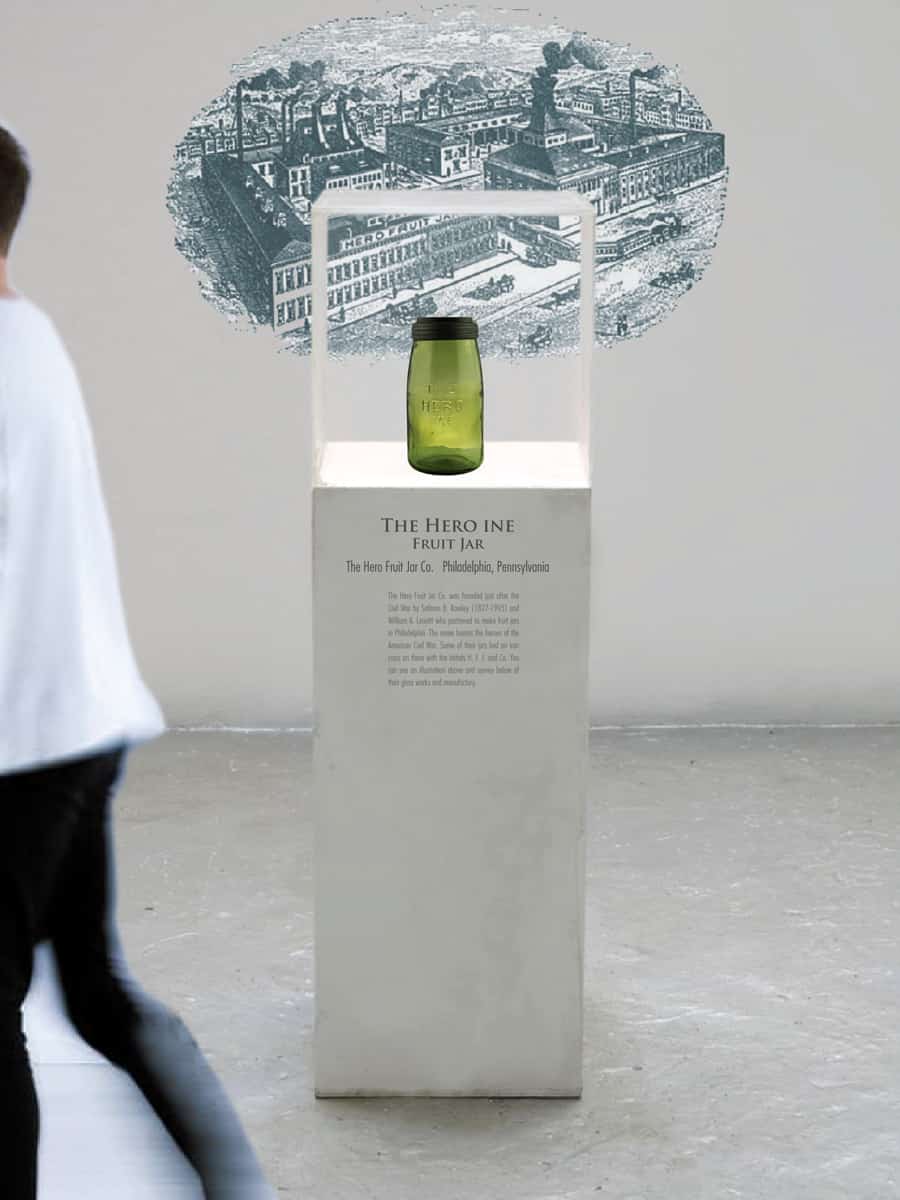
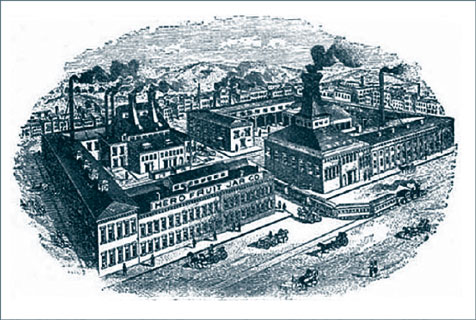
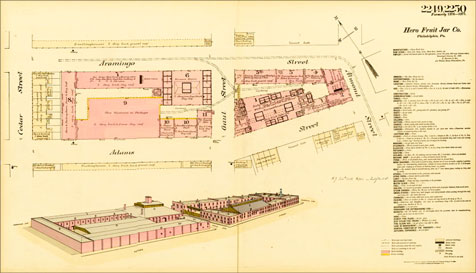
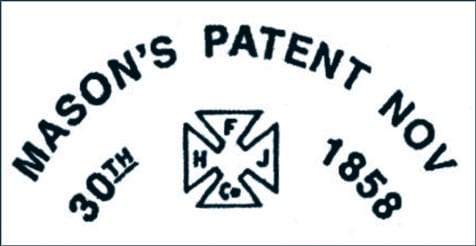
The Hero Fruit Jar Co. was founded just after the Civil War by Salmon B. Rowley (1827-1905) and William A. Leavitt who partnered to make fruit jars in Philadelphia, Pennsylvania. The name honors the heroes of the American Civil War. Some of their jars had an iron cross on them with the initials H. F. J. and Co. You can see an illustration and survey below of their glassworks and manufactory.
Rowley, a native New Yorker, was previously a jobber with the Lockport Glass Works who specialized in lid design and listed every patent date possible on his lids and jars. Some of the jars associated with Rowley are Hero, Gem, Pearl, Crystal, and Porcelain Lined.
See museum examples of the Hero Fruit Jar and Gem Butter Jar.
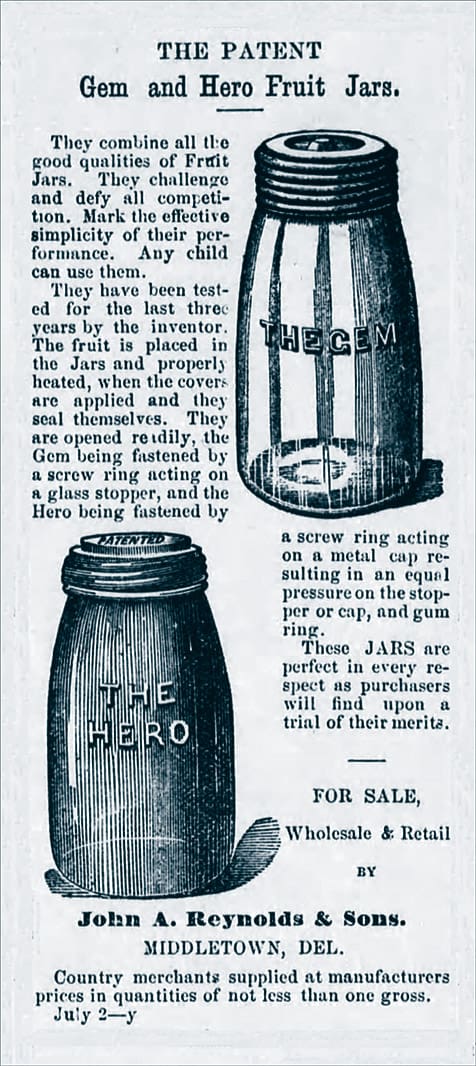
Rowley’s idea was a top-sealing jar with a metal or glass lid straddling the ground lip that was held down by a zinc band. His advertising said that there were four reasons why his Hero Fruit Jar was the best in the market.
The 1st was the rubber packing that made the joint. It would rest on a smooth shoulder which was blown in the mold instead of being ground down on the end. Consequently, there was no nicking out of glass in grinding to let the air into the jar, which was the cause of so much fruit being spoiled.
The 2nd benefit was that you would see that the rubber was away from the fruit, whereas the ground shoulders or ends, must necessarily bring one edge of the rubber in contact with the fruit.
3rd benefit. You could test or loosen the fastenings when the jar or fruit cooled, and see if your cover was tight. If so, you would know at once that your fruit will keep. If the cover is loose, you can heat it over before it spoils.
4th benefit. They are easy to open, which is the most important part of finding a jar that will keep fruit.
Their screw-on lid jars were also competing with Mason jars which were extremely popular at the time. Rowley would sell his Hero jars throughout the country.
We see the first advertisements for Hero and Heroine jars in 1868. Once the Mason patents expired in 1879, Hero adopted the Mason name, although it continued to make the Gem and Hero jars.
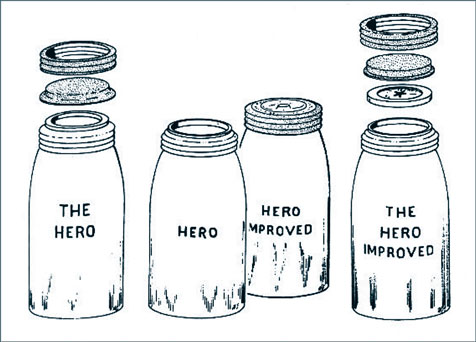
Rowley began to use the name “The Heroine” in 1867. The jars were made by Cunninghams & Ihmsen in Pittsburgh, Pennsylvania from approximately 1865 to 1879 apparently by license from Hero.
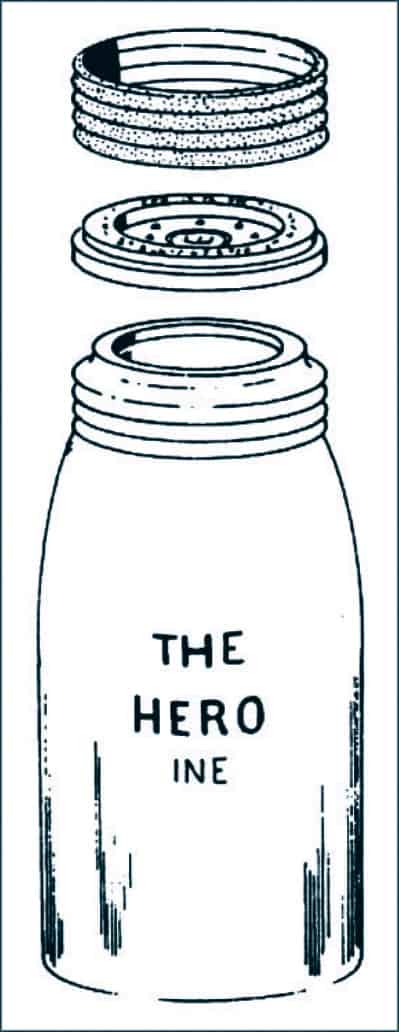
Rowley apparently separated from Leavitt in 1877 and the firm fell into financial difficulty culminating in a sheriff’s sale of the plant and property in 1883. Rowley purchased the firm, incorporated and renamed the operation the Hero Fruit Jar Co. Hero was so successful that it could not keep up with its orders so they had other glasshouses, including the Illinois Glass Co., produce many of its jars. Eventually, the competition became so stiff that Hero ceased glass manufacture to concentrate on lids – ca. 1900. The firm became the Hero Metal Co. in 1909.
Primary Image: The Heroine Jar imaged on location by the FOHBC Virtual Museum midwest studio led by Alan DeMaison.
Support: Reference to Red Book #11, the Collector’s Guide to Old Fruit Jars by Douglas M. Leybourne, Jr.
Support: Reference to Fruit Jar Annual 2020 – The Guide to Collecting Fruit Jars by Jerome J. McCann
Support: Hidden History of Kensington and Fishtown by Kenneth W. Milano
Support: The Hero Glass Firms by Bill Lockhart, Beau Schriever, Bill Lindsey, and Carol Serr
Join the FOHBC: The Virtual Museum is a project of the Federation of Historical Bottle Collectors (FOHBC). To become a member.