
John Moffat Phoenix Bitters Price 2 Dollars New York (M-109)
John Moffat
Phoenix Bitters
New York
Price 2 Dollars
M 109
John and William B. Moffat, New York City, New York
Olive Amber
Provenance: Chris Bubash Collection
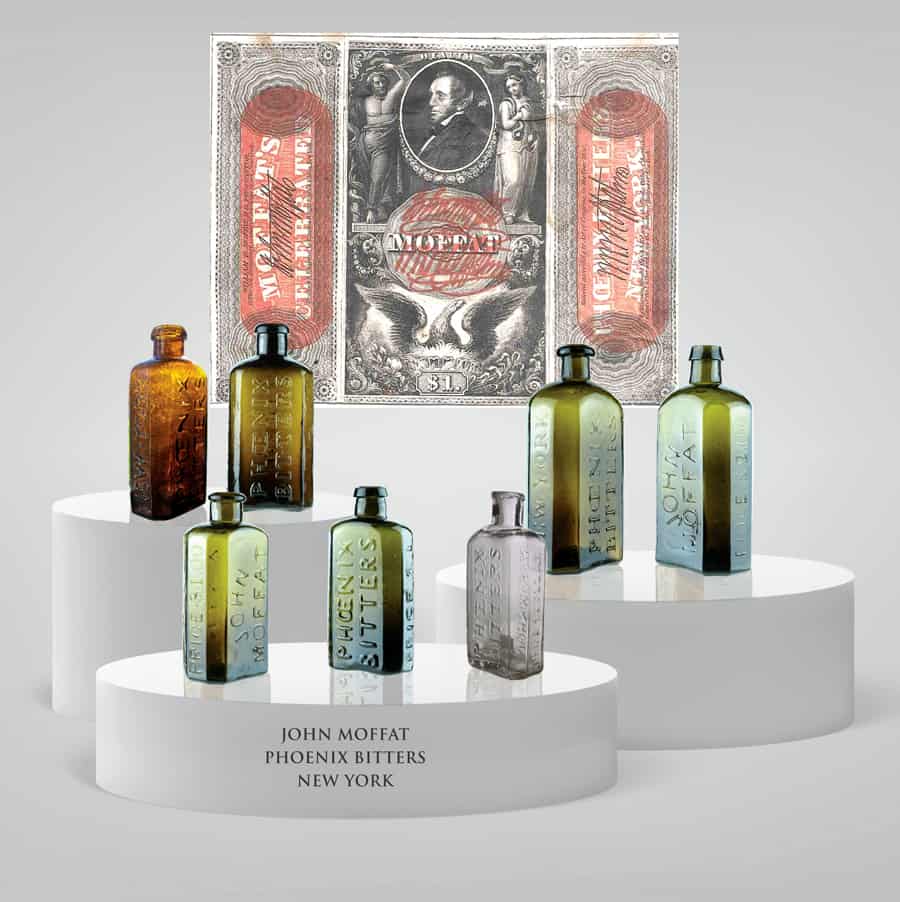
John Moffat Phoenix Bitters include some of the earliest embossed colored pontiled bitters bottles. Their “Stoddard Medicine” shape, pleasing New England colors, and extensive embossing makes them very attractive to collectors. The bottles were made in a number of variants which we have assembled in the museum.
John Moffat was born on August 3, 1788. He married Rachel Marie Brinckerhoff, daughter of Isaac Brinckerhoff and Sophie Quackenbos, on September 10, 1816, in Troy, New York. They would have a son, William Brinckerhoff Moffat, who was born in New York City on March 17, 1818.
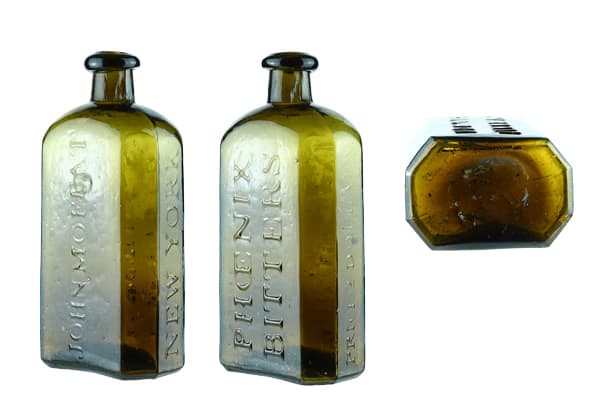
John Moffat Phoenix Bitters bottles can be found in two sizes, a larger two-dollar size (sixteen ounces) and a smaller one-dollar size (eight ounces). The two (2) two-dollar sizes are listed as M108 and M109, with the M109 rated as extremely rare. The M109 is the featured bottle in the museum display, which includes all variants. This 7-inch tall example is olive amber, rectangular with beveled corners, and has a sheared mouth with a crudely applied ring collar. There is a sand-type pontil scar and it is in perfect condition with just a trace of faint wear. The provenance is ex James Chebalo collection.
There are five (5) one-dollar size variants listed from M110 to M114. All bottles are pontiled and, in all, were made from 1837 to about 1867. See Ring & Ham John Moffat Phoenix Bitters catalog numbers.
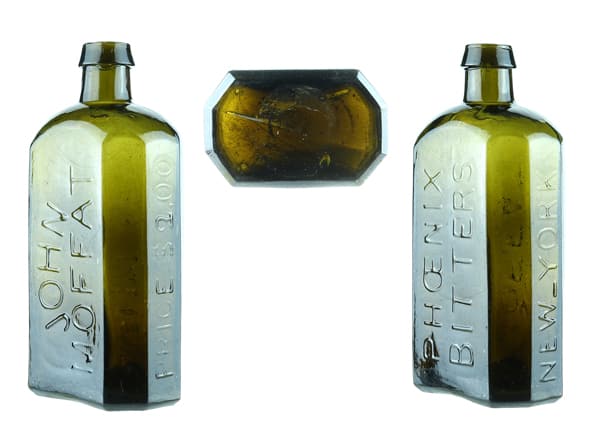
See the museum example of the larger size M 108 John Moffat Phoenix Bitters New York Price $2.00
See the museum example of M 112 John Moffat Phoenix Bitters Price $1.00 New York
See the museum example of M113 John Moffat Phoenix Bitters Price 1 Dollar New York
John Moffat would like you to believe that the origin of his Life Medicines was the result of his protracted and painful illnesses. When Moffat became ill, he reported that he was a prosperous and flourishing merchant in the lower part of Manhattan in New York City. He consulted and employed a “number of skillful physicians, and after months of suffering was prevailed upon to purchase the recipe of the invaluable preparation.” In his case, the effect of these “Life Medicines” was singular and remarkable. So much so that he immediately determined to offer to the world his Moffat’s Vegetable Life Medicines and his Phoenix Bitters that saved his own life and his happiness.
Other Moffatt advertising indicated that he was a doctor, studied medicine early, and graduated with distinguished honors. However, no records can be found to corroborate this information. He was said to have traveled to Europe to study their medical practices, but no records can be found documenting these trips abroad. During this period of time in America, anyone could “become” a doctor, start up a medical practice, or become the proprietor of a medicine. All one had to do was have a product, order some bottles, start advertising and hang a sign above their door.
John Moffat began his medical practice in New York City around 1824. His earliest versions of his medicines and bitters were introduced at this time to the local populace. Moffat broadened his marketing for Moffat’s Phoenix Bitters in 1834 and 1835, according to almanacs and national newspaper advertisements. His bitters were among the many bitters brands flooding the market, claiming a host of medicinal virtues for a willing audience seeking relief from whatever ailed them. No doubt, the high alcohol and, in many cases, drug content made these products, especially appealing and addictive to many. Touted the “Universal Cure,” when taken at night, Moffat’s formula was said to “promote insensitive respiration and relieve the system of febrile action and feculent obstructions as to produce delightful convalescence in the morning.”
The Phoenix Bitters were so-called because they “possess the power of restoring the expiring embers of health, to a glowing vigor throughout the constitution, as the Phoenix is said to be restored to life from the ashes of its own dissolution.” John Moffat would cast a wide net to capture his customers as he addressed his advertising to females, parents and others, elderly persons, heads of families, and mothers and nurses.
William Brinckerhoff Moffat, John’s son, entered the business and worked his way up to oversee the manufacturing operations. They would distribute the Life Pills and Phoenix Bitters from 367 Broadway in New York City. When his father retired from the business in the 1840s, the company was transferred to William, who knew all aspects of the operation. By 1839, the New York City directory listed William B. Moffat as the proprietor of Phoenix Bitters. William Moffat amassed a considerable fortune by manufacturing and selling his medicines.
Until William B. Moffat’s marriage in 1854, his relationship with his father was cordial. Shortly after the marriage, the father brought suit against the son for a dissolution of the copartnership that he claimed had existed between them in the Life Pills and Bitters business during the preceding ten years. He was asking for an accounting of the profits of that business. The son denied the copartnership and succeeded in the litigation (reported as Moffat v. Moffat 10 Bosworth [N. Y.] 468), which was very bitter, and resulted in a family estrangement that never healed. The two other children then living took sides with their father against William B., who retained the business and the wealth.
William B. Moffat died on April 11, 1862, and was followed by his father John on November 6, 1863. About this time, the product was patented in 1862.
See the Museum example M 110 Jno. Moffat Phoenix Bitters New York Price $1.
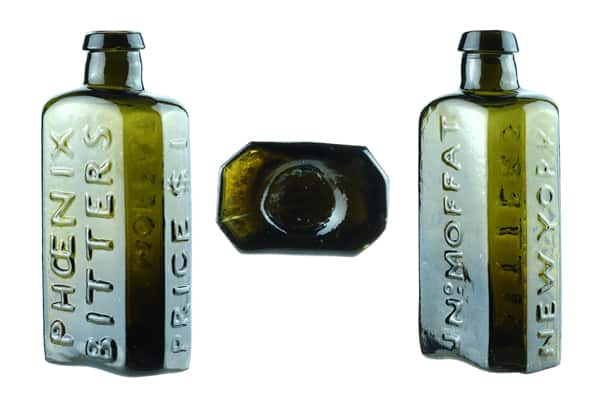
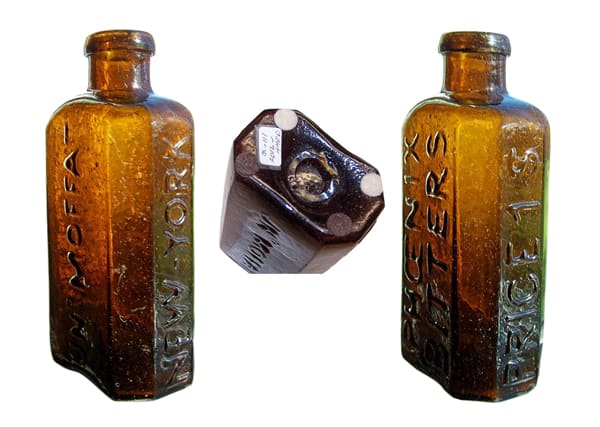
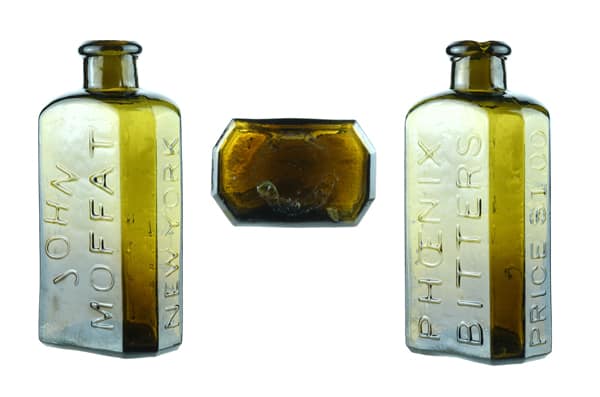
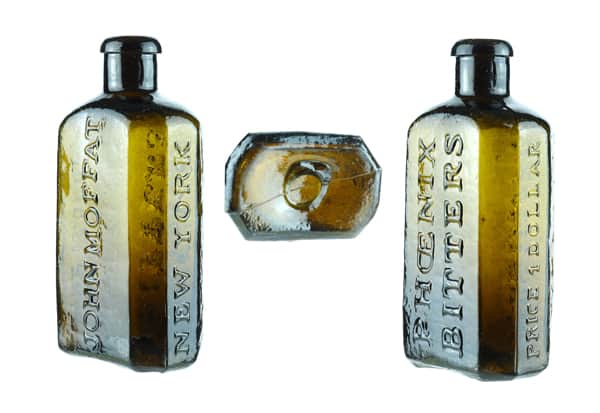
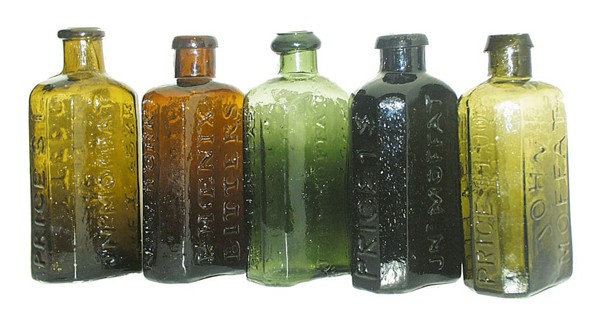
Primary Image: M 109 John Moffat Phoenix Bitters New York Price $2.00, M 108, John Moffat Phoenix Bitters New York Price 2 Dollars, M 110 Jno. Moffat Phoenix Bitters New York Price $1, M 112 John Moffat Phoenix Bitters New York Price $1.00 bottles imaged on location by Alan DeMaison, FOHBC Virtual Museum Midwest Studio
Support (Museum Example): Auction Lot 190: “John Moffat – New York – Phoenix / Bitters – Price 2 Dollars”, a New England glasshouse, 1840-1850. Olive amber, rectangular with beveled corners, sheared mouth with crudely applied ring collar – sand type pontil scar, ht 7″; (just a trace of faint wear, otherwise perfect!) R/H #M109. Noted by R/H as “Extremely Rare”, and certainly considered by many as one of the “holy grails” of all the Phoenix Bitters. Outstanding character and condition. Provenance: James Chabalo collection – John Pastor, American Glass Gallery, Auction #24
Support (Museum Example): Auction Lot 171: “John / Moffat – Phoenix / Bitters – Price $2,00 New_York”, America, 1845-1855, Clear medium olive with an amber tone, rectangular with beveled corners, applied sloping collar – sand type pontil scar, ht. 7″, very near mint; (the bottle appears as virtually attic mint, but may have been very lightly cleaned). R/H #M108. Very rare as noted by R/H. A great example, nice character, one of the most desirable of all the Phoenix molds. Ex. David Ellis collection. – John Pastor, American Glass Gallery, Auction #20
Support (Museum Example): Auction Lot 213: “John / Moffat – Phoenix / Bitters – Price $1,00 – New_York”, America, 1840-1855, Yellowish olive amber, rectangular with beveled corners, sheared mouth with crudely applied ring-type collar – blowpipe pontil scar, ht. 5 1/4″, virtually attic mint R/H M#112. A great example, crude, early, virtually no high point wear, excellent condition! – John Pastor, American Glass Gallery, Auction #17
Support (Museum Example): Auction Lot 241 “Phoenix / Bitters / Price 1 Dollar / John Moffat / New York” Bitters Bottle, America, 1840-1860. Rectangular with wide beveled corners, medium to deep yellow olive, heavy outward folded mouth – tubular pontil scar, ht. 5 1/2 inches; (potstone on a beveled panel has three 1/8 inch legs, light exterior high point wear). R/H #M-113 An attractive example with numerous small bubbles and bold embossing. Generally fine condition. – Norman Heckler Jr. & Sr., Norman C. Heckler & Company, Auction #189
Support Image: Eight early Moffat Almanacs for years 1845, 1847, 1848, 1849, 1852, 1853, 1856, and 1860. Also included is an early un-opened box of Moffat’s Life Pills, c. 1850. – American Glass Gallery, Auction #21
Support Image: Reproduction of an 1860 John Moffat Phoenix Bitters broadside.
Support: Reference to John Moffat’s Phoenix Bitters by Bill Ham, Antique Bottle & Glass Collector, April 2006.
Support: Reference to Bitters Bottles, Bitters Bottles Supplement, and Bitters Bottles Supplement 2, Ring, Ham, Meyer
Support: Reference to PeachridgeGlass.com – Jack Stecher and his John Moffat Phoenix Bitters, December 2012, John Moffat Phoenix Bitters Support, December 2012, Looking at a Moffat Billhead, January 2019.
Join the FOHBC: The Virtual Museum is a project of the Federation of Historical Bottle Collectors (FOHBC). To become a member.