Ta Tsing Bitters
Ta Tsing Bitters
The Great Chinese Remedy
R. S. Gardner & Co.
Proprietors
Clarksburg, W. Va.
T 4
Robert Skiles Gardner, Clarksburg, West Virginia
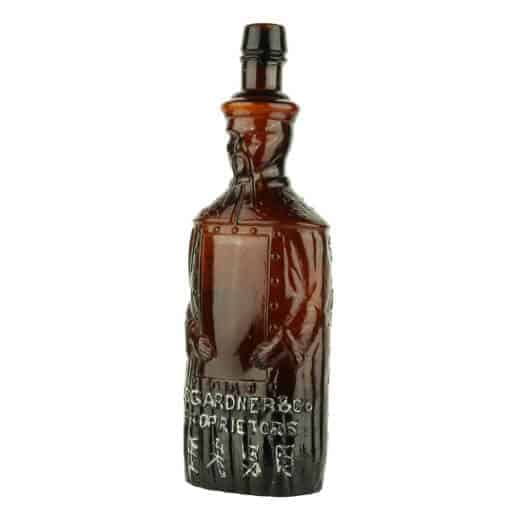
Amber Figural Chinaman
Provenance: Ferdinand Meyer V Collection

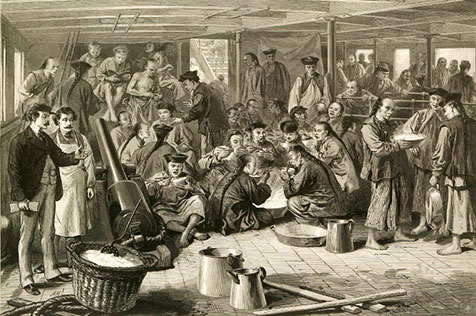
The history of Chinese Americans or the history of ethnic Chinese in the United States includes three major waves of Chinese immigration beginning in the 19th century. The first Chinese people of this wave arrived around 1815. Subsequent immigrants that came from the 1820s up to the late 1840s were mainly men.
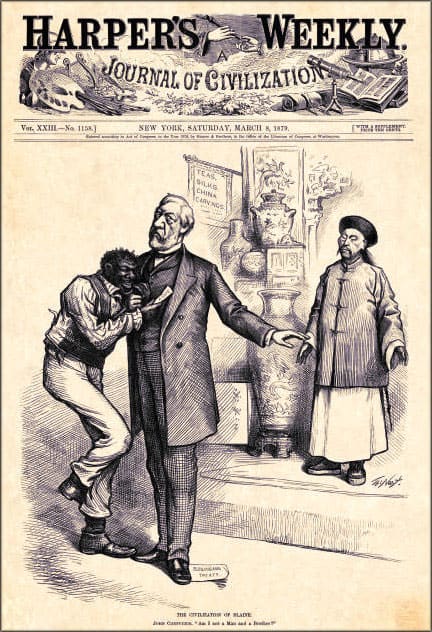
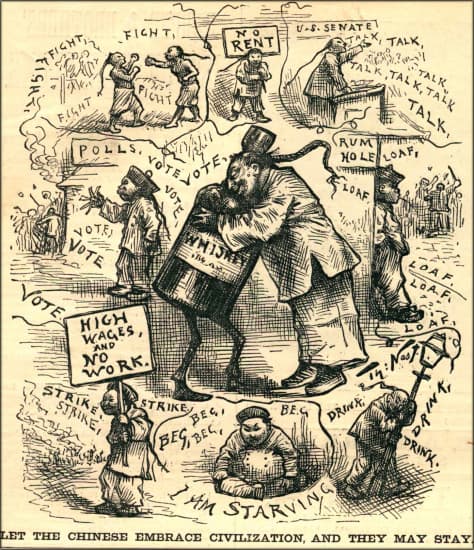
Chinese immigrants in the 19th century worked as laborers, particularly on transcontinental railroads such as the Central Pacific Railroad. They also worked as laborers in mining and suffered racial discrimination at every level of society. Industrial employers were eager for this new and cheap labor, whites were stirred to anger by the “yellow peril.” Despite provisions for equal treatment of Chinese immigrants in the 1868 Burlingame Treaty, political and labor organizations rallied against immigrants of what they regarded as a degraded race and “cheap Chinese labor.”
Within this historical context, it is interesting that two Clarksburg, West Virginia businessmen teamed together to make and sell Ta Tsing Bitters using a figural of a Chinaman or Confucius who was traditionally considered the paragon of Chinese sages emphasizing personal and governmental morality, the correctness of social relationships, justice, kindness, and sincerity.
Meigs Jackson, whose name is on the patent drawing, was an established attorney that most likely financed the brand while Robert S. Gardner, whose name is embossed on the bottle, had military experience as a Quartermaster and was the proprietor of the bitters.
Ta Tsing is most likely in reference to the Burlingame – Seward Treaty which was initiated as the Treaty of Tianjin on June 18, 1858, between the United States and the Ta-Tsing empire. This treaty was signed in July 1868 and outlined a friendly relationship between the two countries and gave both China and the United States the rights to move freely in each other’s respective countries. The new treaty also established some basic principles that aimed to ease immigration restrictions and represented a Chinese effort to limit American interference in internal Chinese affairs.
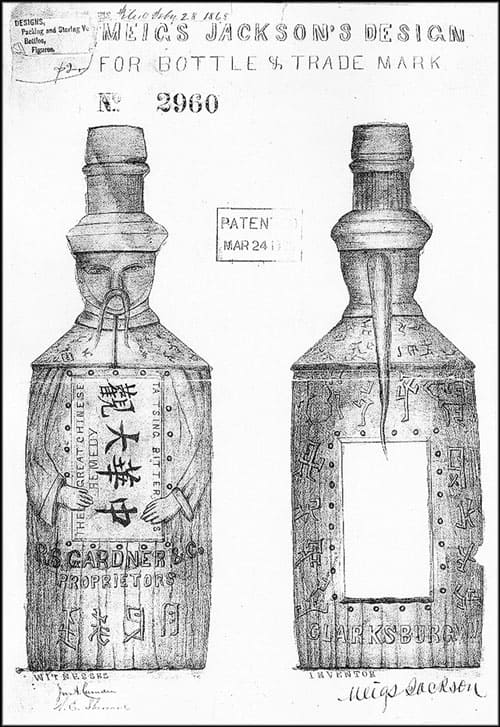
The museum is fortunate to have on display an excellent example of a Ta Tsing Bitters bottle. This is a label-only figural bitters so the word “Bitters” is not embossed on the bottle. “The Chinaman,” as it is affectionately called, has plenty of other embossed details including Chinese text characters, the owner’s name, ‘R. S. GARDNER & CO PROPRIETORS’, and location, ‘CLARKSBURG, W. VA.’ The figure has a long pigtail on the back of the bottle and has a Fu Manchu mustache. There is a prominent smooth embossed placard that is being held by two hands on the front of the bottle. On the patent drawing, the sign reads, “The Great Chinese Remedy and Ta Tsing Bitters” with four (4) Chinese characters. There is a label area on the reverse of the bottle. No labeled example is extant though Carlyn Ring and W. C. Ham record that a label was seen reading, “Ta Tsing Bitters The Great Chinese Remedy.” You can see all this best illustrated on the Meigs Jackson trademark drawing.
We can best learn of Meigs Jackson and R. S. Gardner by looking at two historical sketches.
DEATH OF MEIGS JACKSON
The Weston Democrat, April 03, 1876
The sad intelligence of the death of Meigs Jackson reached Clarksburg, on Thursday. He died at his residence in Nevada, Missouri, on Wednesday evening, 22d last, of pneumonia. Meigs Jackson was born in Clarksburg in 1843 and was the son of the late Major James M. and Mrs. Caroline Jackson.
When he grew up, he studied law and commenced the practice of his profession in Washington City, in 1864. In 1865 he returned to Clarksburg and associated himself with Hon. C. S. Lewis, and soon obtained a lucrative practice. In 1869 he removed to Nevada, Missouri, where he soon attained distinction at the bar. Shortly after he settled in Missouri, he returned to Clarksburg and married an estimable young lady of this place, who accompanied him to his new home. In the autumn of 1874, he returned with his family to Clarksburg and remained until October 1875, when he and his family returned to Missouri.
Mr. Jackson was a genial, warm-hearted gentleman who made friends of all with whom he came in contact. He had fine legal and literary attainments. His personal integrity was of the highest order. His industry was very great, and he was fast rising to distinguished eminence as a jurist.
He was the grandson of Hon. John G. Jackson, who became so distinguished in the early history of Clarksburg. He leaves a wife and one little son, and a mother, brother and sister, and numerous other relatives and friends to mourn his death. He was well known and well-beloved by all our citizens. His remains will reach Clarksburg this morning and will be interred in the family burying ground.
ROBERT SKILES GARDNER
The necessities of war brought into service some of the best business talent and integrity in the Union. When vast forces were to be moved, or supplied with food or clothed, it required rare ability to accomplish it promptly and with the least friction. To many, the face fronting this sketch will be familiar as of the U. S. Quartermaster’s Department.
R. S. Gardner was born in Bellfontaine, Ohio, on January 18, 1839. His father, Isaac S., was a native of Pendleton county, and his Grandfather, Andrew, of Front Royal, Virginia. His education was in common schools, Geneva Hall and Ohio Wesleyan University at Delaware. He graduated from Cincinnati Law school, April 1860. June 6, 1861, he joined the Twenty-third Ohio Regiment, was promoted to Quarter-Master Sergeant, then Regimental Quarter-Master, then Captain and Assistant Quarter Master of Volunteers on Pope’s staff; Depot Quarter-Master at Clarksburg from January, ’63, to February, ’64, and at Harper’s Ferry from March to November, ’64; then Assistant Chief Quarter-Master Depot of West Virginia, with the rank of Major, to June 1865; Depot Quarter-Master at Wheeling to March 12, 1868, when he was mustered out of service.
Major Gardner was also in the mercantile business at Clarksburg to April 1879, when he was made Special Agent in the United States Indian Service April 19th, 1879, to June 30, 1880, then Indian Inspector, and served to June 30, 1888, and reappointed the Special United States Indian Agent March 16, 1889. He crossed the Continent thirteen times, and inspected and visited every agency of Indians from two to six times. He possesses superior business qualifications, and in all public stations rendered faithful and efficient service.
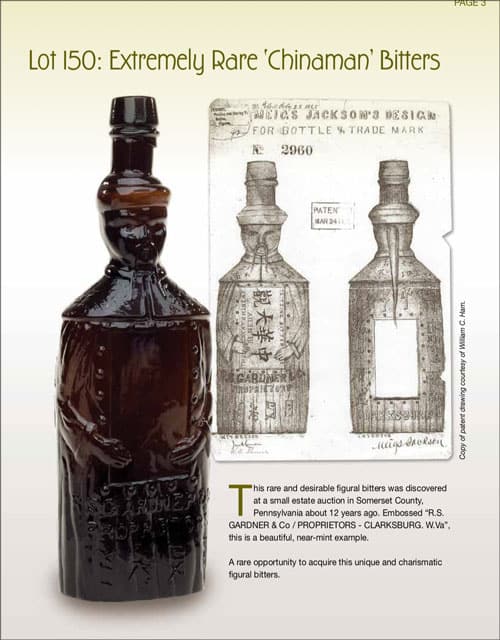
The Carlyn Ring and W.C. Ham listing in Bitters Bottles is as follows:
T 4 L … Ta Tsing Bitters The Great Chinese Remedy
// b // R. S. GARDNER & CO. / PROPRIETORS / CLARKSBURG, W. VA. //
11 x 3 ½ x 2 ½
Figure of a Chinese man with long pigtail
Amber, Applied mouth
Design patent No. 2960 issued to Meigs Jackson of Clarksburg, West Virginia on March 24, 1868
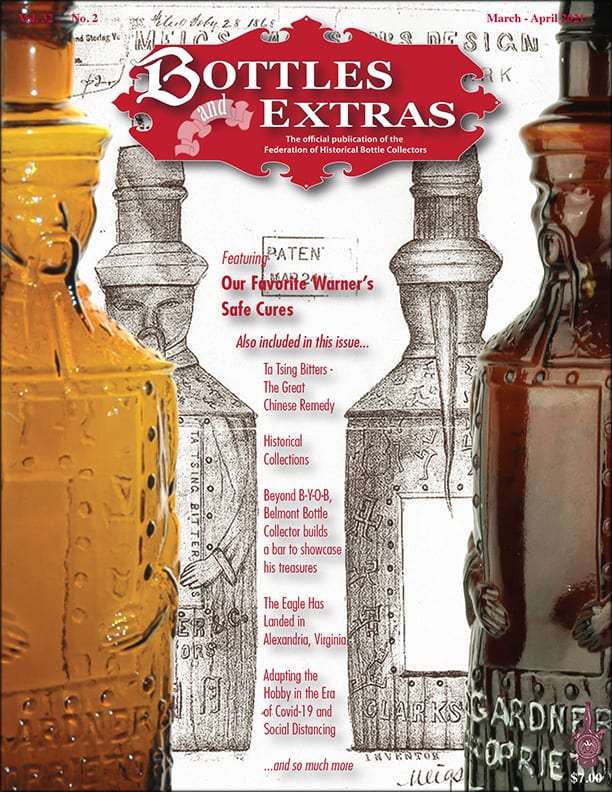
Primary Image: Ta Tsing Bitters imaged on location by Alan DeMaison, FOHBC Virtual Museum Midwest Studio
Support Image: Ta Tsing Bitters from the Sandor P. Fuss collection in light golden amber. Ex: Meyer and Gray collections.
Support: Reference to Bitters Bottles by Carlyn Ring and W. C. Ham.
Support: Reference to Robert Skiles Gardner – Prominent Men of West Virginia: Biographical Sketches, the Growth and Advancement of the State, a Compendium of Returns of Every State Officer by George Wesley Atkinson and Alvaro Franklin Gibbens, 1890
Join the FOHBC: The Virtual Museum is a project of the Federation of Historical Bottle Collectors (FOHBC). To become a member.