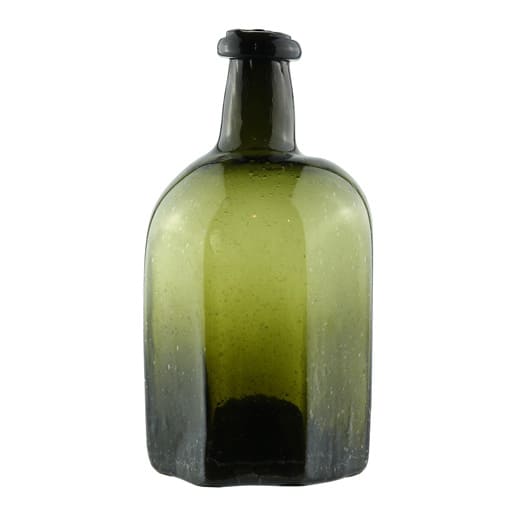
Utility Bottle – Multi Sided
Utility Bottle – Multi Sided
Probably a East Hartford, Connecticut or Germantown, Massuchusetts glassworks
Dark Olive Green Utilitarian Bottle
Provenance: Richard S. Ciralli Collection
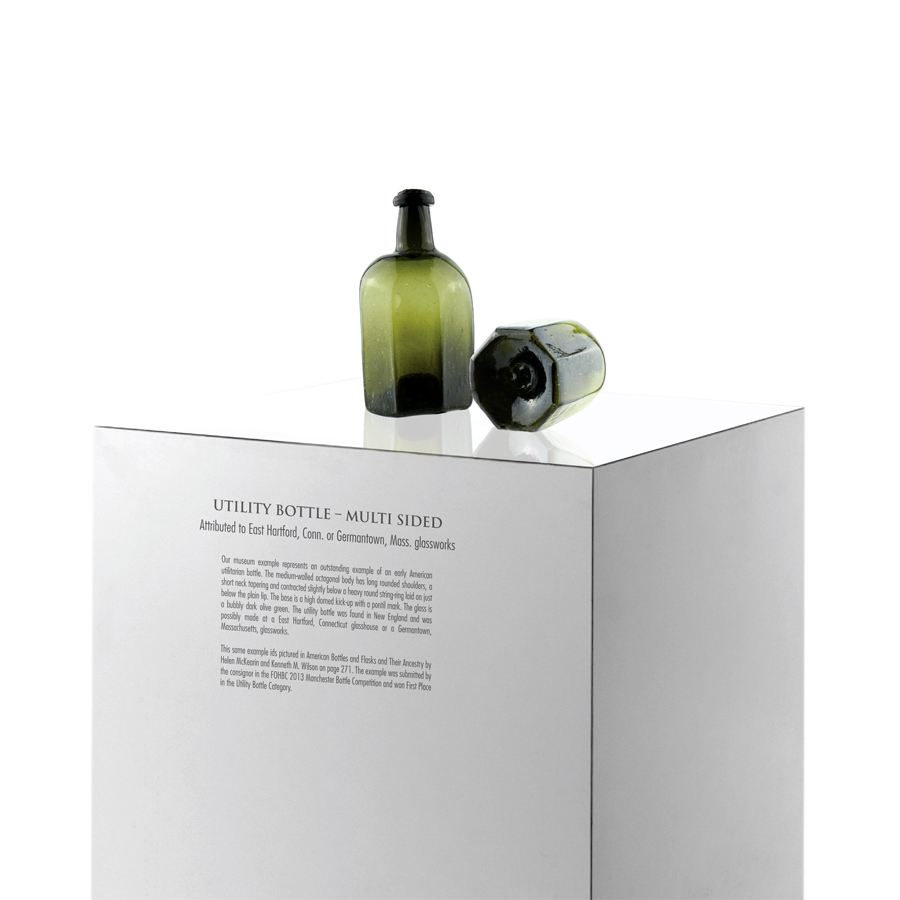
Our museum example represents an outstanding Early American multi-sided utility bottle that probably contained some type of household food product. The medium-walled octagonal body has long rounded shoulders, a tall tapering neck that contracts slightly below an applied heavy round string-ring laid on just below the plain lip. The base is a high domed kick-up with a pontil mark. The glass is a bubbly dark olive green. The utility bottle was produced in New England and was possibly made at an East Hartford, Connecticut or a Germantown, Massachusetts glassworks.
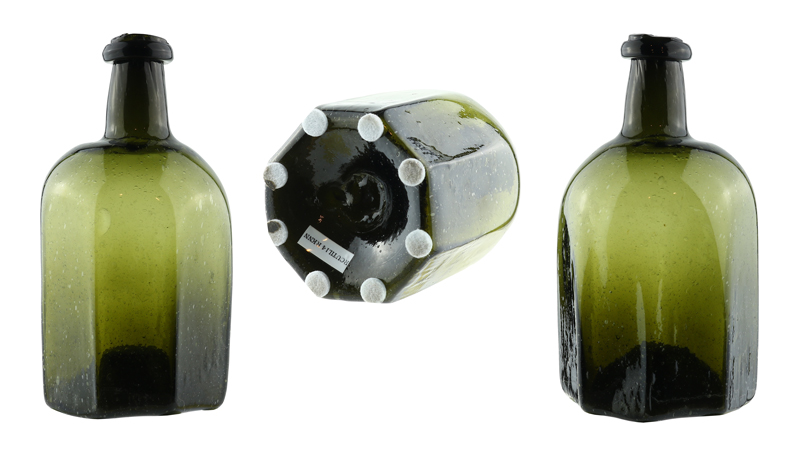
A similar example is pictured in American Bottles and Flasks and Their Ancestry by Helen McKearin and Kenneth M. Wilson in the Utilitarian Bottles, 18th–early 19th Century section on page 271 (second row, 3rd from left).
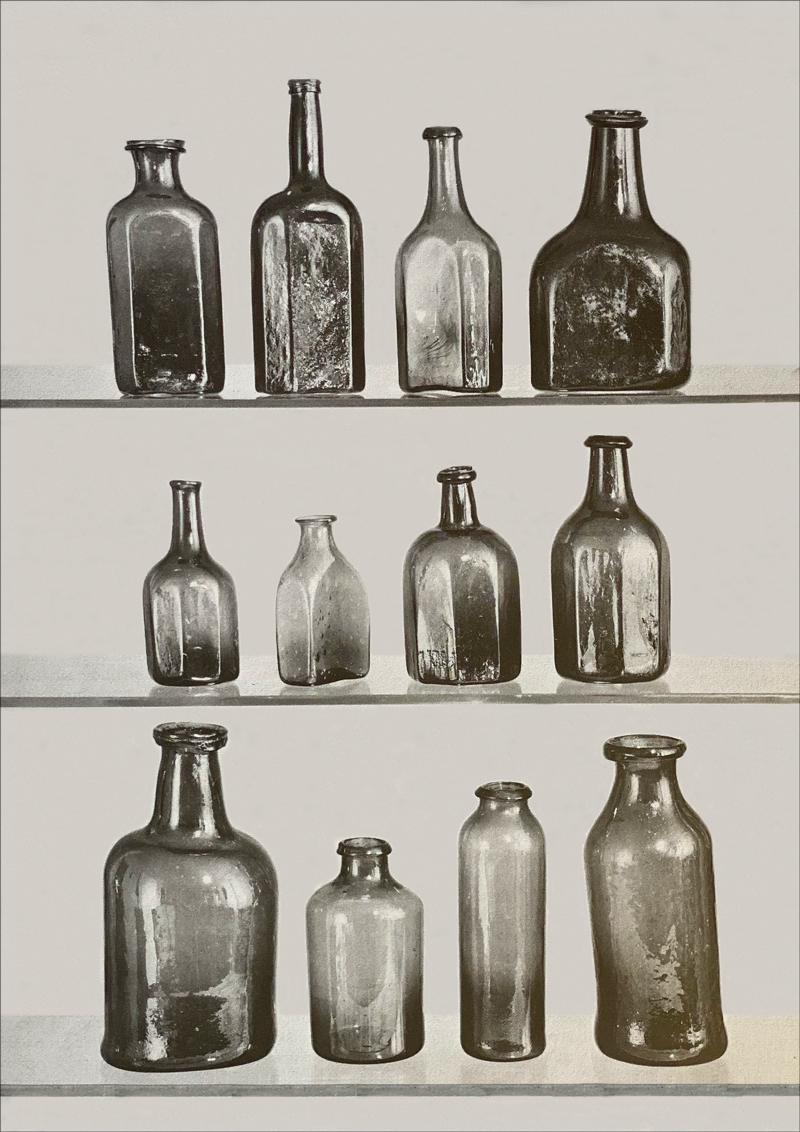
The twelve bottles illustrated above represent international types of utility bottles that undoubtedly were blown in many American glasshouses. The cylindrical bottles, Nos. 9, 11, and 12 on the bottom row were free-blown. The others, Nos. 1 through 8 and 10, were blown-molded for body form in wooden or clay molds. The sides of the rectangular (with and without chamfered corners) and the octagonal bottles arch at the top, blending into the shoulders.
Around 1830, probably even earlier, bottles of the same body forms were blown in full-size two-piece molds, and aquamarine joined the natural dark bottle glass colors. Nos. 1 and 4 above and the cylindrical bottles were given wide mouths, a feature less often seen on bottles found today than the same forms with more slender necks and narrow mouths. Evidence as to the functions of early wide-mouth bottles is slight but it suggests that flour or mustard, powdered preparations, and various kinds of pickles and preserves were numbered among their contents.
Nos. 2, 3, 5, 7, 10, and 11, formerly in the George S. McKearin collection. Nos. 1, 4, 6, 8 9, and 12, are from the Corning Museum of Glass. – American Bottles and Flasks and Their Ancestry
This same museum example was submitted by the consignor in the FOHBC 2013 Manchester National bottle competition and won First Place in the Utility Bottle Category. Read The New England Bottle Battle in the September–October 2013 issue of Bottles and Extras.
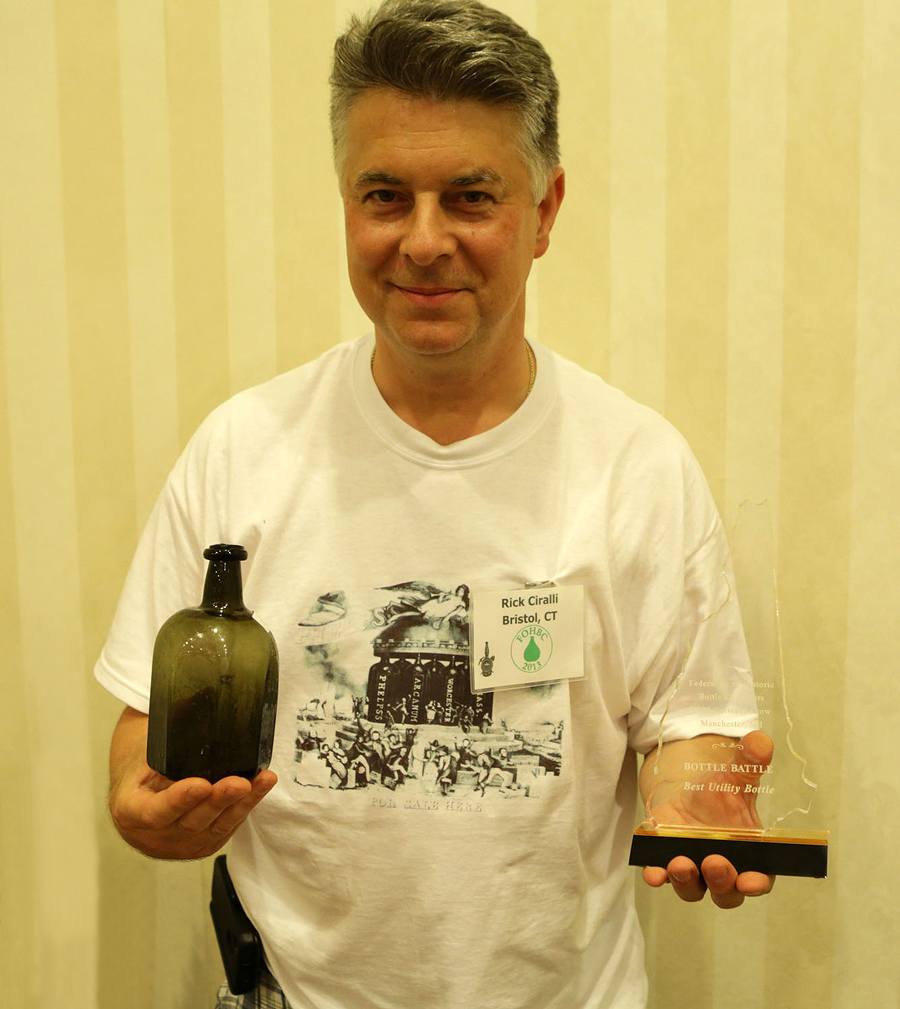
Primary Image: Multi-Sided Utility Bottle imaged on location by Alan DeMaison, FOHBC Virtual Museum Midwest Studio
Support: Reference to American Bottles and Flasks and Their Ancestry by Helen McKearin and Kenneth M. Wilson, Crown Publishers Inc., New York, 1978.
Support: Reference to the September–October 2013 issue of Bottles and Extras.
Join the FOHBC: The Virtual Museum is a project of the Federation of Historical Bottle Collectors (FOHBC). To become a member.